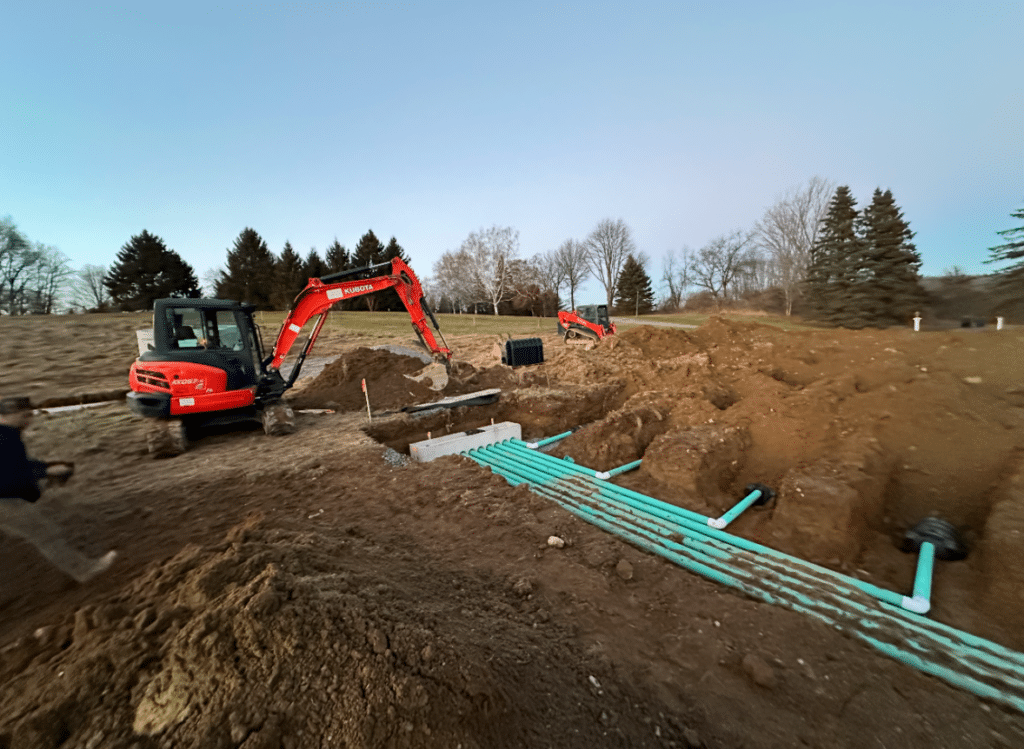

Living in the Pocono Mountains comes with incredible natural views. But it also comes with heavy spring snowmelt, intense summer downpours, and rocky clay soil. If your yard turns into a marsh after rainfall or water pools around your foundation, you have a drainage problem that will not fix itself.
Excess groundwater and surface runoff cause serious issues for local homeowners. Water seeps into basements, washes away landscaping, and causes soil erosion. Even worse, water pooling in your yard can flood your septic tank or saturate your leach field, causing sewage to back up into your home.
When looking for a solution, two terms come up repeatedly: French drains and curtain drains.
While people often use these terms interchangeably, they are distinct systems designed to tackle different water problems. Installing the wrong one wastes time and money while leaving your property vulnerable.
Here is what you need to know about how these systems work, how they differ, and which one will protect your Pocono property.
Understanding Water Movement in the Pocono Mountains
To choose the right drainage system, you must understand where your water problem originates. Mountain terrain creates two distinct types of water flow:
-
Surface Water: Rainwater or melting snow running across topsoil and driveways.
-
Subsurface Groundwater: Water absorbed into the ground, moving beneath the soil surface along rock ledges and clay strata.
In places like Lackawaxen, PA, and surrounding Pike County communities, shallow bedrock and dense clay soils prevent rainwater from absorbing quickly. When groundwater hits an impermeable rock layer, it travels horizontally. If your house sits in the path of that underground flow, hydrostatic pressure builds up against your foundation walls or saturates your septic drain field.
Different water sources require different solutions. A system designed for surface water will not fix a high water table, and a deep groundwater drain will fail if surface water washes sediment over top of it.
What Is a French Drain?
A French drain is a gravel-filled trench containing a perforated pipe designed to capture and redirect groundwateraway from specific structures.
The concept is simple: water takes the path of least resistance. Liquid flows through the surrounding gravel, enters small holes in the pipe, and flows downhill to a safe discharge area like a storm ditch, dry well, or lower point on your lot.
Key Components of a Proper French Drain
A long-lasting French drain consists of four critical elements:
-
A Sloped Trench: Dug near a foundation or troubled area, sloping down at least 1 inch for every 10 feet of run.
-
Filter Fabric: Heavy-duty geotextile fabric lines the entire trench to prevent dirt, clay, and silt from clogging the system.
-
Perforated Pipe: Rigid PVC or smooth-interior corrugated pipe with holes facing down to collect water as it rises.
-
Washed Crushed Stone: Clean 3/4-inch stone surrounds the pipe, providing open space for water to move quickly.
Where French Drains Excel
French drains are installed deep—often level with or just above a home’s foundation footings (around 2 to 6 feet deep). They act as a protective barrier, stopping underground water from pressing against basement walls or floor slabs.
If your basement walls seep water after heavy rain, or if your yard stays muddy long after snow melts because the underground water table is high, a deep French drain is usually the correct fix.
What Is a Curtain Drain?
A curtain drain is a specialized type of French drain installed shallowly to intercept and divert surface water and shallow runoff before it reaches a specific area.
Think of a curtain drain as an underground barrier placed upstream on a slope. It cuts off sheet flow water moving across your lawn, wrapping around a protected zone like a curtain.
How a Curtain Drain Differs
While a curtain drain uses similar materials (perforated pipe, stone, and filter fabric), its placement and depth are entirely different:
-
Depth: Installed shallow, usually 12 to 24 inches below the surface.
-
Location: Placed uphill from a house, yard area, or septic leach field to catch water flowing down a mountain slope.
-
Surface Integration: Often topped with turf or decorative stone so surface water drops straight into the trench.
Where Curtain Drains Excel
If you live on a slope and water rushes down the hill into your driveway, outdoor living area, or septic system, a curtain drain acts as a diversion ditch. It intercepts that water at the top of the slope and routes it around your home before it can cause damage.
Side-by-Side Breakdown: French Drain vs. Curtain Drain
Comparing these two systems directly helps clarify which setup fits your situation:
Primary Purpose and Target Water
A deep French drain targets underground water and high water tables pressing against structures. A curtain drain targets surface runoff, water pooling on lawns, and shallow subsurface flow moving across sloped yards.
Depth and Excavation Needs
Deep French drains require significant trenching, often 2 to 6 feet deep, requiring heavy excavation equipment. Curtain drains are shallower, typically 12 to 24 inches deep, making installation faster with less soil disruption.
Placement Relative to Structures
Deep French drains sit immediately adjacent to foundation walls, footings, or retaining walls. Curtain drains are positioned uphill, further away from structures, to cut off water before it reaches low points.
Impact on Septic Drain Fields
Curtain drains are frequently used uphill from septic leach fields (“turkey mounds”) to divert surface water and keep the soil absorption area dry. Deep French drains are used to lower water tables near septic tanks or protect deep utility lines.
How Poor Drainage Impacts Your Septic System
For homes without municipal sewer connections, poor yard drainage threatens your household septic system.
When heavy rain or melting snow swamps your yard, excess water saturates the soil around your septic tank and leach field. This causes severe, expensive problems:
-
Hydraulic Overload: Too much surface water soaking into your drain field prevents household wastewater from filtering through the soil, leading to plumbing backups inside your house.
-
Drain Field Failure: Constant saturation destroys the natural bacterial balance in engineered mound systems (“turkey mounds”), causing premature clog formation.
-
Effluent Pump Overwork: If groundwater leaks into your septic tank or pump chamber through unsealed risers, effluent pumps run continuously, leading to premature motor failure.
Installing a shallow curtain drain uphill from a septic leach field diverts water away from your absorption area, protecting your investment and keeping your system compliant with health standards.
Why Quality Construction Matters in the Poconos
Digging a trench and throwing a pipe in the ground might sound simple, but DIY drainage projects in Pike County often fail within two years.
Common installation mistakes include:
-
Using the Wrong Pipe: Thin, black corrugated pipe crushes easily under vehicle weight and catches debris in its interior ridges. Rigid PVC with smooth interiors lasts much longer and flows faster.
-
Skipping Filter Fabric: Without non-woven geotextile fabric, native clay soil quickly washes into the gravel and clogs the pipe holes.
-
Incorrect Pitch: Drainage pipes must maintain a consistent downhill slope. If a trench dips, standing water creates silt traps that block flow.
-
Unprotected Outlets: The end of the drainage pipe where water exits needs a grate or popup emitter to prevent rodents and leaves from nesting inside.
Professional excavation ensures your trench accounts for local soil compaction, frost lines, and existing utility trenches.
Choosing the Right System for Your Property
Determining whether you need a deep French drain or a curtain drain depends on your specific symptoms:
Choose a Deep French Drain If:
-
Water enters your basement or crawlspace through foundation wall cracks.
-
Your basement floor slab feels damp or shows white mineral powder (efflorescence).
-
You have a chronically high water table surrounding your foundation.
-
You are constructing a new home or addition requiring foundation waterproofing.
Choose a Curtain Drain If:
-
Water rushes down a slope toward your driveway or back patio during heavy storms.
-
Standing water pools on your lawn days after it stops raining.
-
Water flows downhill toward your septic drain field or turkey mound.
-
You want to protect a garden, patio, or lower yard area from surface runoff.
In many mountain properties, a combination of both systems offers the best protection. A curtain drain captures mountain runoff at the property line, while a deep French drain protects the foundation footings.
Complete Septic & Subsurface Services by Triple J Services
Triple J Services delivers specialized subsurface infrastructure work throughout Lackawaxen, PA, and surrounding regions. Built on family values and technical expertise, the team provides complete solutions for complex drainage and septic challenges.
French Drains & Drainage Solutions
Custom-designed deep French drains, shallow curtain drains, and surface water diversion systems protect foundations, yards, and septic fields from water damage.
Excavation & Utility Trenching
Precision excavation capabilities for utility trenching, water lines, sewer connections, and site grading tailored to rocky mountain soil conditions.
Septic System Installation & Replacement
Complete septic system design and installation services built to handle local site topography, soil types, and environmental regulations.
Leach Field (“Turkey Mound”) Repair & Installation
Specialized construction and repair for engineered elevated mound systems, ensuring proper wastewater distribution in shallow bedrock or high water table areas.
Grinder Pump Repair & Installation
Rapid response for grinder pump alarms, control panel resets, cutter blade clearing, and total pump replacements to prevent indoor sewage backups.
Effluent Pump Service & Replacement
Comprehensive testing, maintenance, and replacement for effluent pumps in dosing tanks to maintain proper pressure distribution across leach fields.
Emergency Septic Pumping
Fast emergency pumping services to empty full tanks, clear line blockages, and relieve system pressure during unexpected backups.
High-Pressure Drain Jetting (Hydro-Jetting)
Powerful jetting services using up to 4,000 PSI of water pressure to scour grease, roots, and heavy scale from main drain and sewer lines.
Septic System Inspections
Thorough inspections evaluating tank condition, pump mechanics, float switch operation, and leach field performance for homeowners and home buyers.
External Resources for Further Reading
To learn more about home drainage, soil conservation, and managing water on your property, check out these authority resources:
-
USDA Natural Resources Conservation Service: Water Management – Federal resources on soil health, run-off control, and property drainage practices.
-
PA Department of Environmental Protection: Wastewater Management – Official Pennsylvania guidelines on on-lot sewage systems and environmental protection.
Article Recap
-
French drains target deep groundwater and high water tables near foundations, typically dug 2 to 6 feet deep.
-
Curtain drains target shallow surface runoff and hill slope water, typically dug 12 to 24 inches deep uphill from structures or leach fields.
-
Poor yard drainage leads to basement flooding, severe soil erosion, and septic system failure.
-
Excess surface water soaking into a septic leach field causes hydraulic overload and sewage backups inside the home.
-
Successful drainage systems rely on rigid pipes, clean crushed stone, proper pitch, and heavy-duty geotextile filter fabric.
-
Triple J Services offers custom French drains, curtain drains, excavation, and complete septic services in Lackawaxen, PA, and Pike County.
Take Control of Your Yard Drainage Today
Stop letting rainstorms and snowmelt flood your lawn or threaten your foundation and septic system. Triple J Servicesbrings local expertise, heavy excavation equipment, and dedicated service to every project in Lackawaxen, PA, and surrounding areas.
Call John and the team today at (845) 750-5222 or visit Triple J Services to schedule your drainage consultation!