Imagine you have a plumbing emergency on a cold Friday night. Water is backing up into your shower, and you need an emergency septic pumping immediately. The service truck arrives, the technician steps out, and asks a simple question: “Where is the main tank lid?”
If you look out across your snowy or overgrown yard and shrug, you are in for a long, frustrating night. Instead of fixing the problem right away, the crew will spend precious time hunting for buried infrastructure. They will poke iron rods into your lawn, dig exploratory holes, and run up your labor costs.
Knowing exactly where your underground waste components are located is a vital part of property ownership. It transforms routine care from a stressful guessing game into a simple, predictable chore.
Taking the time to build an accurate layout map of your property saves time, money, and landscaping. It ensures you are fully prepared for routine pump-outs and unexpected structural repairs.
Why a Precise Septic Layout Map Matters
Most homeowners know they have a waste tank buried somewhere in the yard, but they rarely know the exact details. Your waste setup is an interconnected network of pipes, tanks, and filtration zones.
If you do not know the exact route of your main line, you risk driving heavy equipment over it or planting deep-rooted trees that can break the PVC pipe sections.
An accurate diagram is also critical when you plan property upgrades. If you ever want to install a new deck, build a detached garage, or put in a pool, you have to know where the waste components sit.
Building over any part of your waste system can crush the lines or violate local environmental health codes. A map gives you complete architectural freedom while protecting your hidden assets.
The Clues Hidden Inside Your Home
You do not need to start digging up your lawn blindly to find your system. You can gather an incredible amount of information by looking right inside your house.
Start by going down into your basement or crawlspace. Look for a thick, heavy pipe that runs out through your foundation wall toward the yard. This pipe is your main sewer lateral line.
Note the exact spot where this pipe penetrates the foundation wall. Take out a tape measure and locate a window, door, or corner close to that exit point.
Go outside to the exterior wall and find that exact marker. Look straight out into your yard from that spot. Your main waste pipe runs out from this exact location in a relatively straight line. This provides your initial baseline direction.
Gathering Your Historic Paperwork
Before you step onto the lawn with a shovel, check your household records. The easiest way to find your underground layout is to look at official historical documents.
-
The Property Deed and Title: Sometimes older property transactions include rough sketches of the lot’s utilities.
-
The Original As-Built Plan: When a contractor installs a waste setup, they must submit a detailed diagram to the local municipality. This is called an “as-built” drawing. It shows the exact measurements from the corners of your house to the tank lids.
-
Local Health Department Records: In many regions, the local health department keeps records of all permits for a septic system installation and replacement. You can request a public copy of these permits.
-
Previous Home Inspection Reports: If you bought your home recently, the home inspector might have noted the tank’s location or included photos of the lids in their final report.
Locating the Main Holding Tank
If you cannot find any official paperwork, you will need to do some detective work in the yard. The main holding tank is usually buried between ten and twenty-five feet away from your foundation wall.
Walk outside from the point where the main line leaves your basement. Look for subtle changes in your lawn.
Because a large concrete or fiberglass tank sits just a few feet below the surface, the soil over it is shallower than the rest of your yard. In hot weather, the grass over a tank often dries out and turns yellow faster than the surrounding lawn.
Conversely, in early spring, the heat from the wastewater can cause the grass over the tank to grow faster and look greener.
You can also look for slight depressions or low spots in the dirt. Over decades, the soil packed around a buried tank can settle, leaving a shallow crater on the surface.
If your yard is perfectly flat, you can use a professional soil probe—a long, slender metal rod with a T-handle. Gently push the probe into the ground along the path of the main line until you hit a solid concrete or fiberglass barrier. This tells you the exact depth and edge of your tank.
Finding Your Leach Field or Turkey Mound
Once you find the main tank, you need to trace where the liquid goes. Clarified wastewater leaves the holding tank and flows into your filtration area.
In some yards, this is a traditional gravel trench system buried completely out of sight. In many parts of the Poconos, thin rocky soil requires an engineered alternative. You will frequently see an elevated sand mound, known locally as a “Turkey Mound.”
Finding a Turkey Mound is incredibly simple because it rises clearly above the natural grade of your yard. Traditional fields are tougher to spot, but you can look for parallel lines of lush, green grass during dry seasons.
Keep all heavy traffic completely off this entire zone. Driving a car, truck, or ATV over your field can crush the internal plastic lines or compact the soil, causing the system to fail completely.
If your yard has natural grade issues that cause surface water to pool near your filtration zone, you should look into installing targeted French drains and drainage solutions to redirect rainwater away from this sensitive area.
Mapping Your Grinder and Effluent Pumps
Hilly or uneven terrain means gravity cannot always move waste efficiently. Many modern properties rely on mechanical pump units.
A grinder pump pulverizes solid waste and pumps the slurry uphill to a municipal connection or main tank. An effluent pump moves clarified fluid out to a distant filtration mound.
These pumps sit inside their own dedicated underground chambers, separate from the main holding tank. You can usually find them by looking for an exterior electrical control panel mounted on the side of your house or on a wooden post in the yard.
Follow the line of sight from that control panel out into your yard. You will usually find a heavy green or black plastic lid secured with heavy screws.
Mark this spot clearly on your new map. If you ever hear your pump alarm buzzing or notice your drains slowing down, knowing exactly where to find the pump housing ensures a technician can perform a fast grinder pump repair or effluent pump replacement without searching the property.
How to Draw Your Final Map
You do not need to be a professional artist to create a highly functional property map. You just need to be accurate and consistent with your reference points.
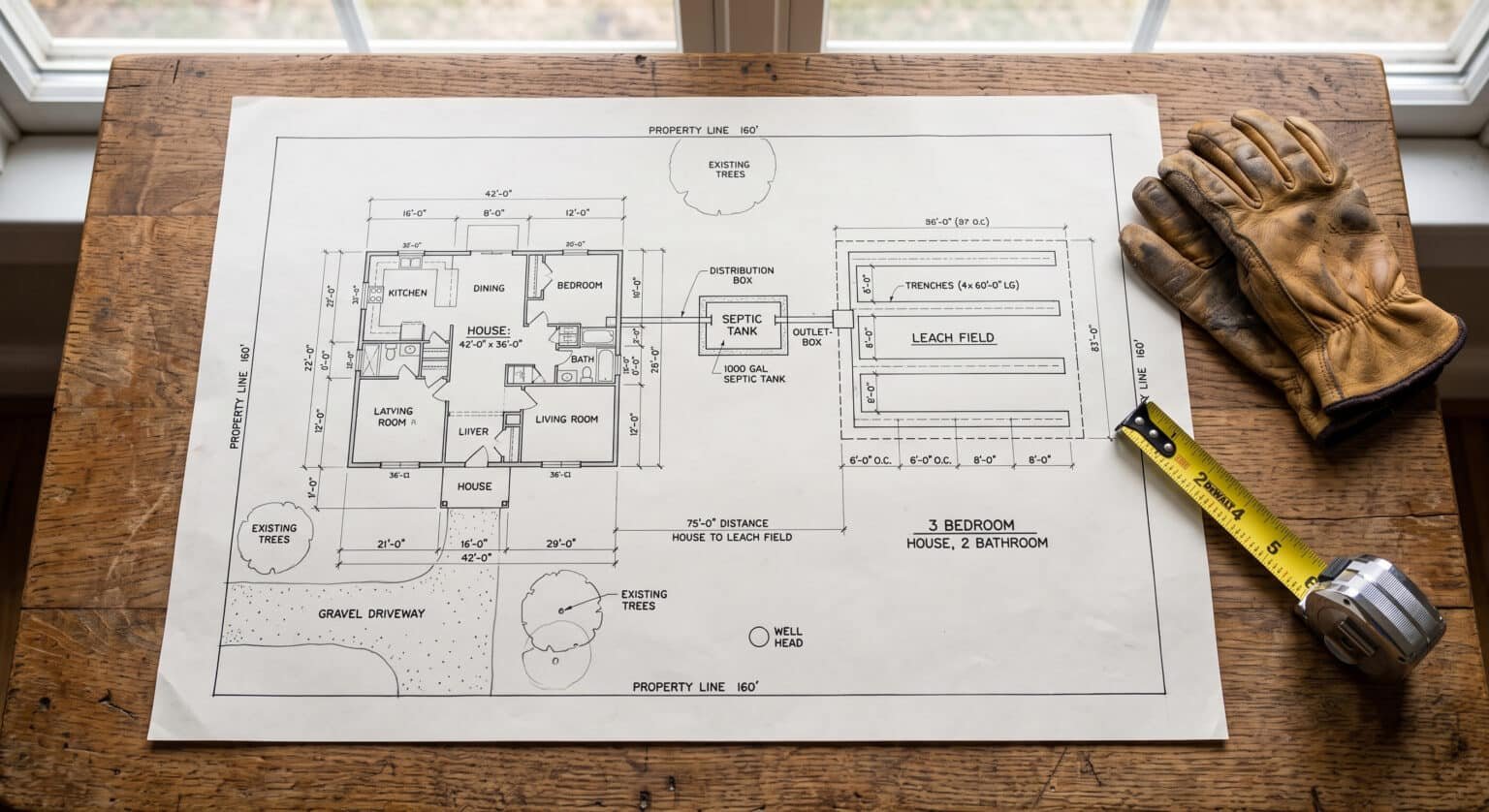
Grab a sheet of grid graph paper, a long tape measure, and a pencil. Start by drawing the basic outline of your house. Label the corners of the house as your primary reference markers (for example, “Northeast Corner”).
Measure out from those exact corners to the center of your tank lid. Draw a straight line on your graph paper and write down the exact distance in feet (such as “18 feet from NE Corner”).
Next, measure the distance from the main tank to the beginning of your filtration field or Turkey Mound. Outline the borders of the field on your paper.
If your system uses a pump chamber, plot that location as well. Be sure to note where your main freshwater line runs from your well to the house so you never confuse the two utilities.
Once your drawing is finished, make a digital copy on your phone and store the physical paper inside your main home maintenance folder or tape it directly to the wall next to your electrical panel.
The Power of High-Pressure Hydro-Jetting
Once you have your map drawn, maintaining your infrastructure becomes significantly simpler. You will know exactly where to direct technicians for routine checkups or specialized maintenance. One of the best preventative actions you can take once your lines are mapped is clearing them out completely.
Over years of use, grease, soap scum, and small debris accumulate along the inner walls of your main waste lateral. This narrows the pipe and can cause frequent clogs.
Traditional drain snakes only punch temporary holes through clogs. High-pressure drain jetting, or hydro-jetting, uses intense water streams to scrub the inside of your pipes completely clean.
Knowing the exact path of your lateral line allows technicians to apply this pressure safely, clearing out every bit of debris without risking damage to hidden joints.
When to Call for a Professional Septic Inspection
If you have tried using soil probes and searching for old permits but still cannot find your underground components, do not start digging random trenches across your yard. You can cause severe structural damage to your pipes or slice through buried electrical lines.
Instead, schedule a professional septic system inspection. Modern technicians use advanced technology to locate components without tearing up your lawn.
They can feed a flexible sewer camera down your main line from inside the house. These cameras feature built-in radio transmitters.
As the camera moves through the pipe, the technician walks across your yard with a handheld locator wand that tracks the signal from above ground. This allows them to mark the exact path of your lines and the location of your tank lids down to the inch.
An inspection also gives you a complete health check, identifying small structural cracks, sagging pipes, or invasive tree roots before they trigger an emergency backup.
Excavation, Trenching, and Modern Upgrades
Sometimes, mapping your system reveals that your utility lines are buried dangerously shallow. According to installation safety codes from organizations like the Occupational Safety and Health Administration (OSHA), any underground utility trenching must be managed carefully to avoid structural collapses and protect critical water lines.
If your lines sit above the regional frost line, they are highly vulnerable to freezing and splitting during harsh Pennsylvania winters.
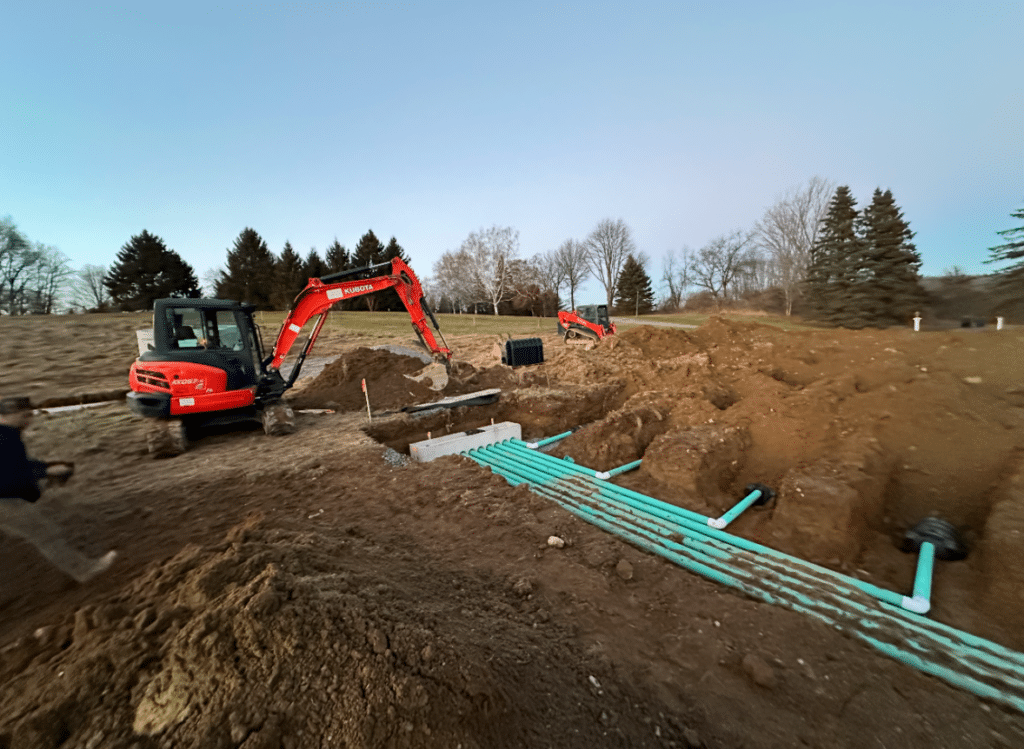
If your lines are shallow, or if you are dealing with an ancient, failing tank, you may need to invest in professional excavation and utility trenching to bury your infrastructure safely deep underground.
If your current system is simply too old to handle your household demands, planning a complete septic system installation and replacement ensures your home remains safe, clean, and fully compliant with modern environmental codes for decades to come.
Reliable Local Service in Lackawaxen
When you need help locating, maintaining, or repairing your essential waste infrastructure, you want to work with a team that truly knows our local community. A distant corporate chain or a general contractor won’t bring the same level of care and specialized tools as a dedicated neighbor.
Triple J Services is located right here in Lackawaxen, PA. We treat every single property across Pike County like it belongs to our next-door neighbor.
Our owner, John Dreizler, built this company on a foundation of grit, family values, and total honesty. We don’t believe in shortcuts, and we never make inflated promises to earn a quick profit.
We focus our training, equipment, and expertise strictly on subsurface utilities, pump systems, and excavation work. We don’t try to be a jack-of-all-trades; we simply master the essential infrastructure services that keep your home running flawlessly.
Whether you need a routine location inspection, high-pressure hydro-jetting, an emergency pump-out, or a full system replacement, we are here to deliver top-tier workmanship with genuine pride and integrity.
Article Recap
-
Creating an accurate septic layout map saves time, minimizes lawn damage, and prevents expensive utility line accidents during property renovations.
-
You can find the initial path of your main waste line by checking where the thick lateral pipe exits your basement wall.
-
Historical records, such as as-built drawings and local health department permits, often contain exact measurements for your buried tank.
-
Surface clues like yellowing grass in summer, rapid growth in spring, or slight soil depressions point directly to the location of a holding tank.
-
Keep all vehicle traffic entirely off your leach field or Turkey Mound to avoid compacting the sand layers or crushing buried distribution pipes.
-
Electronic locator wands used during professional sewer camera inspections can trace underground lines precisely without any digging.
-
Storing a completed map near your electrical panel ensures you are completely prepared for routine pumping or sudden mechanical emergencies.
Stop guessing where your infrastructure is hidden and protect your property investment today. Whether you need professional help locating your tank lids, want to schedule a routine inspection, or require high-pressure hydro-jetting to clear out slow lines, the local team at Triple J Services is ready to help.
We bring the advanced camera tech, heavy excavation tools, and specialized septic expertise needed to keep your systems running smoothly.
Give us a call today at (845) 750-5222 or visit our Services Page to request your free estimate. Let us take care of the hard work so you can enjoy total peace of mind.