Property owners rarely think about wastewater treatment until a major issue surfaces. If you rely on an on-lot wastewater system, a formal evaluation can feel highly stressful. Finding out that your setup failed a state or local municipal inspection can immediately trigger anxiety about massive expenses, legal issues, and property damage.
A failed inspection is a serious situation, but it is not an unsolvable disaster. Understanding the regulatory landscape, knowing why systems fail, and identifying the exact steps to correct the issue can make the recovery process manageable.
Triple J Services, located in Lackawaxen, Pennsylvania, specializes in diagnosing, maintaining, and restoring residential and commercial systems throughout Pike and Wayne Counties. Understanding local rules and technical requirements ensures you can resolve compliance failures quickly, safely, and affordably.
The Landscape of Septic Regulations in Pennsylvania
Navigating wastewater compliance in Pennsylvania requires looking at how the Commonwealth structures its environmental laws. Unlike states that use a single, centralized department to handle every local issue, Pennsylvania distributes enforcement across its local governments.
The Power of Act 537
The foundational law governing on-lot wastewater treatment across the Commonwealth is the Pennsylvania Sewage Facilities Act, widely known as Act 537. Passed originally in 1966 and updated periodically, this statute requires every single municipality in Pennsylvania to develop, implement, and enforce a comprehensive sewage facilities plan.
The primary goal of Act 537 is to protect public health and prevent environmental contamination by ensuring that domestic wastewater is treated uniformly and safely. Because the state delegates this authority down to individual townships and boroughs, your exact rules depend entirely on where your property is located. A homeowner in Lackawaxen Township might experience different municipal maintenance schedules or real estate transfer requirements than a property owner in a neighboring county.
The Role of the Sewage Enforcement Officer
Because local municipalities run these programs, day-to-day enforcement falls on a specialized local official called the Sewage Enforcement Officer, or SEO. The SEO is a state-certified professional who works on behalf of the local municipality.
An SEO handles several critical responsibilities: conducting formal soil profile examinations and percolation tests, reviewing engineered designs, and issuing mandatory installation or repair permits. They also perform final open-trench inspections before an underground system can be covered, investigate reported system malfunctions or environmental complaints, and enforce local point-of-sale ordinances during property transactions.
When a system undergoes a formal evaluation and fails, the SEO is the official who documents the violation and issues the formal non-compliance notices.
Why Do Septic Systems Fail Inspections?
An on-lot system can fail a municipal or state evaluation for many reasons, ranging from minor mechanical glitches to catastrophic structural collapses. Understanding the specific nature of the failure helps determine whether you need a simple component replacement or a full system redesign.
Direct Structural Failures
The physical components of an underground system degrade over decades of continuous exposure to moisture, soil pressure, and corrosive gasses. Concrete septic tanks can develop severe cracks above or below the water line, leading to groundwater infiltration or raw wastewater exfiltration. Baffling systems inside the tank can snap off, allowing solid waste to escape directly into the absorption area. Additionally, heavy vehicle traffic across a yard can crush fragile PVC transport lines or settle distribution boxes, completely cutting off effluent flow.
Absorption Area Malfunctions
The soil absorption field, often called the leach field or drain field, is the final treatment phase of your system. Over time, poor maintenance can cause solids to escape the main tank and clog the porous spaces in the soil. This blockage leads to a biological slime layer known as a biomat, which prevents the soil from absorbing liquid. When the ground loses its ability to filter water, effluent forces its way upward, creating marshy, foul-smelling spots in your lawn, or backs up into household plumbing.
Regulatory and Distance Violations
Sometimes a system functions mechanically but fails an inspection due to strict legal rules. Pennsylvania regulations maintain rigid isolation distances to prevent contamination. For example, a system must maintain a minimum distance from private water wells, natural watercourses, and property boundaries. If a past owner installed an unpermitted expansion or added extra bedrooms without upgrading the system’s design flow capacity, the entire configuration can fail a modern regulatory audit.
The Immediate Consequences of a Failed Inspection
When an SEO or a certified professional inspector documents a system failure, it triggers a chain of events that requires your immediate attention. Ignoring the situation will quickly escalate the issue from a simple plumbing problem into a costly legal dispute.
Official Non-Compliance Notices
If the failure presents an active health hazard, such as raw sewage surfacing on the ground or backing up into a home, the local municipality will issue a formal notice of violation. This document legally establishes that the property is in violation of local ordinances and Act 537. The notice outlines a specific, binding timeline within which the property owner must stabilize the situation, schedule professional testing, and apply for a valid repair permit.
Impact on Real Estate Transactions
Pennsylvania does not impose a statewide mandate requiring a septic inspection every time a piece of real estate changes hands. However, dozens of local municipalities throughout the state have passed local point-of-sale ordinances that make these evaluations mandatory before a deed can transfer.
Even in areas without local mandates, mortgage lenders, including the FHA and VA, almost always require proof of a functioning septic system before approving home financing. A failed inspection will stop a real estate closing immediately. To keep the sale moving forward, the buyer and seller must negotiate who will pay for repairs, or place significant funds into a formal escrow account to cover future engineering and installation costs.
The Step-by-Step Path to Resolution
Discovering a failed inspection can feel overwhelming, but following a structured, logical sequence ensures you resolve the issue efficiently without wasting money on incorrect fixes.
The moment a failure is identified, your primary goal is to stop active environmental contamination and prevent sewage from backing up into your living spaces. You should immediately reduce your household water use by running fewer loads of laundry and taking shorter showers. Your next move should be contacting a professional provider to pump the septic tank completely. Emptying the tank provides immediate, temporary relief by giving your household wastewater a place to go while you work with professionals to plan a permanent fix.
Once the system is stable, you must figure out exactly why it failed. A certified inspector from an experienced company will use specialized cameras to look inside underground plumbing lines, examine the tank walls, and evaluate the distribution box. If the absorption area is completely ruined, you will need to involve the local SEO to explore your options for a replacement field. This phase often requires conducting new soil profile analysis and percolation tests to find out how quickly the soil absorbs water, which determines what type of replacement system can legally be built on your lot.
Under Pennsylvania law, you cannot perform significant repairs, alter components, or replace an absorption field without a valid permit issued by the municipal SEO. If your soil tests reveal poor drainage or a high seasonal water table, a conventional stone-and-pipe leach field may not be legally permissible. In these challenging scenarios, you must work with a qualified designer or engineer to develop a specialized layout. This plan might utilize an elevated sand mound, a drip irrigation system, or an advanced aerobic treatment unit approved under the Pennsylvania Department of Environmental Protection (PA DEP) guidelines. Once the design is finished, it is submitted to the SEO for formal permit approval.
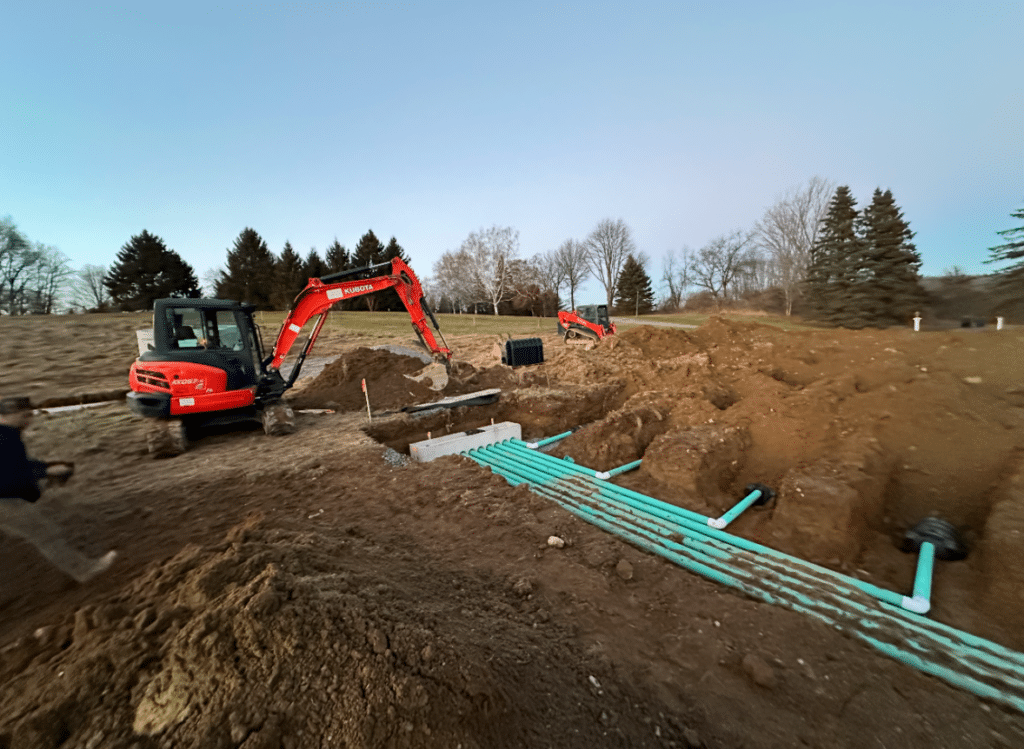
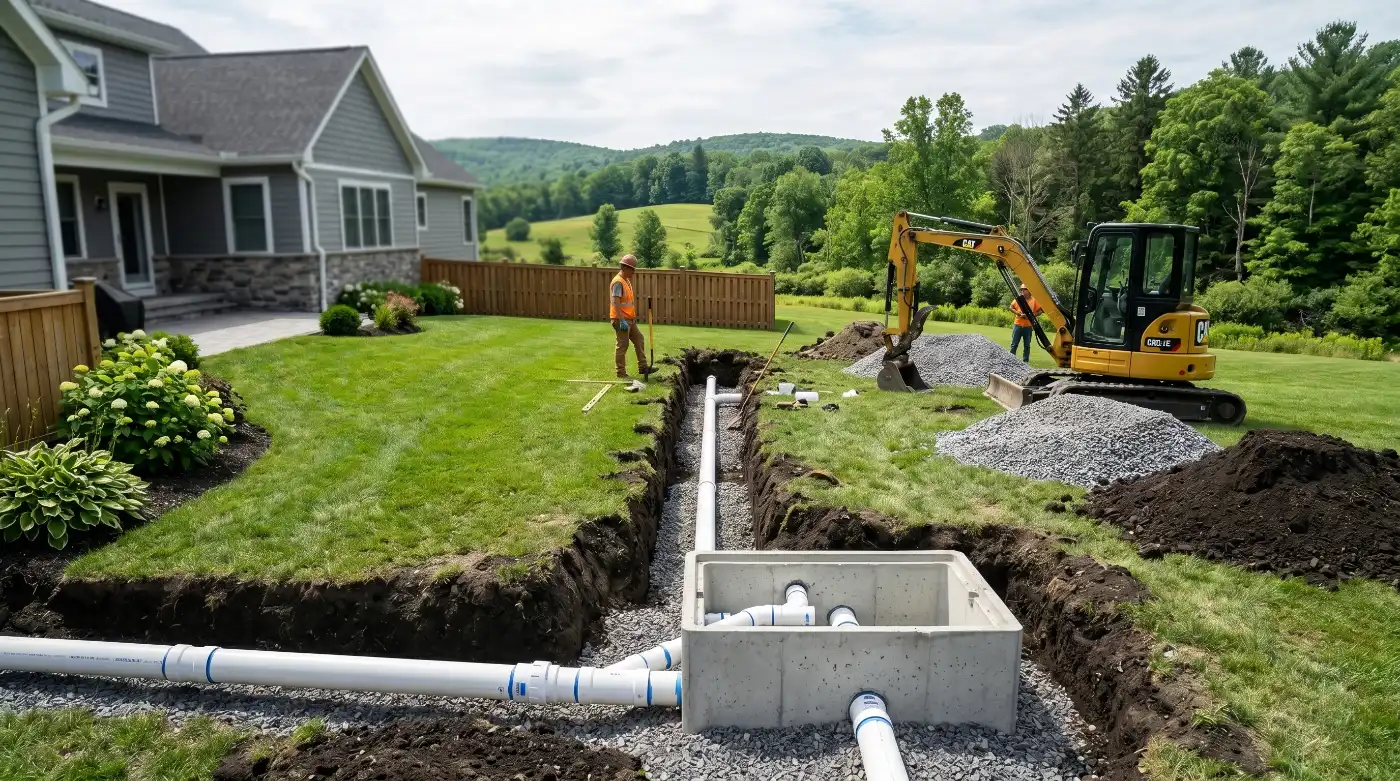
With the approved permit in hand, an experienced excavation and septic installation team can begin constructing the new system. The process involves precise earthmoving, component placement, and pipe routing according to the approved engineering specifications. Before the contractor can backfill the trenches and cover the system with soil, the local SEO must come out to the property for a final open-trench inspection. The officer verifies that all isolation distances are respected, slope elevations are perfect, and materials comply with state codes. Once the SEO gives final written approval, the system can be covered, seeded, and put back into full service.
Exploring Alternative System Options for Difficult Sites
Many properties in northeastern Pennsylvania feature challenging geography, including tight lot lines, steep slopes, shallow bedrock, or heavy clay soils that drain poorly. If your conventional system fails on one of these difficult parcels, a standard replacement field may not be an option. Fortunately, modern wastewater technology offers several state-approved alternative setups designed to handle these exact limitations.
Elevated Sand Mounds
An elevated sand mound is one of the most common alternative options used across Pennsylvania. When a site has shallow soil sitting above a limiting zone like bedrock or a high water table, a conventional trench cannot provide enough natural filtration. To solve this, installers build a sand filter bed above the natural ground level. Wastewater is pumped from a dosing tank up into the mound, where it filters through a specific depth of clean sand before filtering gently down into the natural soil below.
Advanced Aerobic Treatment Units
Conventional systems rely entirely on anaerobic bacteria to break down waste inside a dark, oxygen-deprived tank. Aerobic treatment units take a different approach by actively forcing air into the treatment chamber. This oxygen-rich environment allows aerobic bacteria to thrive. These organisms break down organic waste much faster and more thoroughly than anaerobic bacteria. The resulting effluent is significantly cleaner, which protects fragile soils and extends the total lifespan of a replacement absorption field on a tight lot.
Drip Irrigation Fields
When steep slopes or dense landscaping make it impossible to install a large sand mound, drip irrigation offers a highly flexible, low-impact alternative. This method uses flexible, automated tubing buried just a few inches below the surface of the grass. The treated wastewater is pumped through these lines in small, carefully timed doses, allowing the root systems of your lawn to naturally absorb the moisture. This setup requires minimal excavation and leaves your yard looking natural and undisturbed.
Funding Options for Major Septic Repairs
Replacing an entirely failed wastewater system is a major capital improvement that can strain any household budget. Many homeowners are caught off guard by the total cost of engineering, permits, and heavy excavation. Fortunately, Pennsylvania residents have access to dedicated programs designed to make these essential environmental repairs more affordable.
The Pennsylvania Infrastructure Investment Authority, known widely as PENNVEST, partners directly with the PA DEP and the Pennsylvania Housing Finance Agency to offer low-interest loans specifically for homeowners needing to repair or replace a malfunctioning on-lot system. These long-term, low-rate loans help cover the costs of design, permitting, and construction, ensuring you can bring your property back into full regulatory compliance without facing extreme financial hardship.
Additionally, certain rural property owners may qualify for specialized repair grants or low-interest financing packages provided through the United States Department of Agriculture Rural Development program. Exploring these financial resources early in your planning process can help you organize your budget and move your project forward without unnecessary delays.
Proactive Management: Preventing Future Failures
The best way to handle a failed inspection is to avoid one entirely through consistent, disciplined maintenance. A well-managed system can easily operate safely for decades, protecting your property value and the surrounding environment.
To maintain a healthy system, implement these core practices:
-
Commit to Regular Pumping: A standard residential tank should be professionally pumped every three to five years, depending on your household size. Regular pumping prevents solid sludge and floating scum from flowing out of the tank and permanently ruining your absorption field.
-
Practice Strict Water Conservation: Excessive water use overloads your system, flushing solids out of the tank before they can settle properly. Install low-flow plumbing fixtures, fix running toilets immediately, and space out large laundry loads throughout the week to give your drain field time to rest.
-
Control What Goes Down the Drain: Your system relies on a delicate balance of living bacteria to break down waste. Avoid flushing harsh chemical cleaners, motor oils, paints, solvents, or heavy items like wet wipes and paper towels down your drains. These materials kill beneficial bacteria and cause stubborn physical blockages.
-
Protect Your System’s Footprint: Keep heavy vehicles, livestock, and large machinery completely off your tank and absorption field. Structural weight crushes underground pipes and compacts the soil, ruining its ability to filter water. Additionally, avoid planting trees or large shrubs near your lines, as aggressive root systems will quickly break into pipe joints in search of moisture.
Partnering with Triple J Services in Lackawaxen, PA
Resolving a failed state or municipal inspection requires working with an experienced team that understands both complex environmental science and local township rules. At Triple J Services, we provide dependable structural support, transparent advice, and skilled workmanship to property owners throughout Lackawaxen and the surrounding regions.
We know that dealing with wastewater issues can feel overwhelming. Our team takes a straightforward, practical approach to every project, using modern diagnostic equipment to find the exact source of your failure and laying out your options clearly. From initial tank pumping and camera diagnostics to soil testing, permitting coordination, and complete system installation, we manage the entire process smoothly. We ensure your property satisfies all Act 537 guidelines, fully protects local groundwater, and provides you with a reliable, long-term wastewater solution.
Quick Article Recap: Septic Inspections
-
Local Enforcement: Pennsylvania implements its overarching Act 537 wastewater regulations through local municipal Sewage Enforcement Officers (SEOs).
-
Common Failure Points: Systems typically fail inspections due to cracked or leaking tanks, structural pipe damage, or a clogged, overloaded absorption field.
-
Immediate Transaction Roadblocks: A failed inspection will stop real estate transfers and mortgage approvals in areas with point-of-sale ordinances.
-
Structured Recovery Steps: Resolving a failure requires immediate tank pumping, professional camera diagnostics, soil percolation testing, and municipal permit approvals.
-
Modern Treatment Options: Difficult properties can utilize advanced engineering solutions like elevated sand mounds, aerobic units, or low-profile drip irrigation lines.
-
Preventative Care: Long-term system health depends on professional pumping every three to five years, regular water conservation, and protecting the drain field from heavy vehicles.
If your system recently failed an inspection or is showing warning signs like slow drains or soggy grass, do not wait for the problem to worsen. Contact the skilled team at Triple J Services today by calling (845) 750-5222 or visiting our contact page to schedule a comprehensive system evaluation and restore your property’s compliance with total peace of mind.