
Executive Summary
-
Property records omit private wastewater systems far more often than expected, particularly in older rural homes across Wayne, Pike, and Monroe counties in Pennsylvania, as well as northern New Jersey.
-
Finding unmapped tanks requires specialized non-invasive tools like flushable micro-transmitters, soil probes, and high-resolution pipe cameras rather than indiscriminate backhoe excavation.
-
Regulatory compliance relies on retroactive mapping to align the existing tank and soil absorption field with local municipal codes and PA DEP or NJ DEP environmental standards.
-
Proactive structural diagnostics prevent system collapse by establishing precise hydraulic boundaries, verifying tank structural integrity, and evaluating soil loading rates.
What to Do if You Inherit a Septic System with No Records
Unlocking the front door of a newly acquired rural home or commercial property in Northeastern Pennsylvania or Northern New Jersey brings immediate excitement, until a plumbing setback reveals a complete absence of wastewater infrastructure records. Purchasing an off-grid cabin, acquiring a historic farmstead, or taking over a commercial lot often leaves property owners with an unmapped, unpermitted private wastewater system.
When a property deed lacks an “as-built” drawing or a municipal permit, every flush carries an element of financial and structural risk. Knowing where the tank sits, how large it is, and whether the drain field functions safely requires systematic investigation rather than guesswork.
To bring an unrecorded septic system into full operational reliability and regulatory compliance, property owners must move through a structured five-step diagnostic process:
-
Document Recovery: Conduct comprehensive searches through municipal archives, deed registries, and historical utility records to surface missing permits.
-
Physical Location: Deploy non-invasive radio micro-transmitters, insulated ground probes, and utility locators to trace underground infrastructure.
-
Structural Audit: Expose access hatches to inspect tank walls, run internal pipe camera diagnostics, check baffle integrity, and perform system pump-outs.
-
Field Assessments: Evaluate soil percolation rates, check distribution boxes for even flow, and test current hydraulic loading capacities.
-
Retroactive Permits: Draft formal as-built site schematics and submit verified system layouts to local health departments for DEP compliance.
Step-by-Step Recovery and Mapping of Unrecorded Septic Systems
Locating and documenting an unrecorded septic system requires starting inside the structure at the main sewer stack, deploying flushable radio-frequency sondes to trace underground lines, and exposing access hatches for visual inspections. Property owners must systematically trace wastewater flow as it moves from the home’s main sewer line exit, travels down solid pipe lines into the main septic tank, flows onward into the distribution box, and finally divides evenly into perforated leach field pipes.
Navigating Municipal Archives and Regulatory Frameworks
Before digging into the soil, check local municipal health departments, regional offices of the Pennsylvania Department of Environmental Protection (PA DEP), or the New Jersey Department of Environmental Protection (NJ DEP). Older properties frequently fall into regulatory gaps where permits were recorded under previous property owners, historical tax lot numbers, or defunct trade names.
If local municipal archives yield no records, review the original property deed and mortgage surveys for easements or utility rights-of-way. Older rural parcels often utilized informal site arrangements, placing component lines near historical property boundaries. Establishing a preliminary timeline based on the age of the primary structure helps narrow down likely tank materials and their primary failure points across distinct construction eras:
-
Pre-1970 Infrastructure: Systems built during this period typically utilize steel tanks, laid brick, or cinder block construction. The primary structural failure point for these aging installations is severe metal corrosion, wall shifting, or complete structural collapse.
-
1970–1990 Installations: This era predominantly featured unreinforced precast concrete tanks. Over decades of exposure to wastewater gases, their primary failure points manifest as concrete baffle erosion, lid degradation, and aggressive tree root penetration.
-
1990–Present Systems: Modern systems rely on heavy-duty polymer units or reinforced precast concrete. Their primary failure points are generally mechanical, including effluent pump burnout, broken float switches, and clogged check valves.
Deploying Non-Invasive Underground Location Technologies
Property owners often assume locating an underground tank requires heavy machinery and widespread yard disruption. Experienced trade specialists trace infrastructure non-invasively by following the primary 4-inch sewer stack out through the foundation footing. Modern diagnostics rely on flushable micro-transmitters (sondes) threaded through the main cleanout, which broadcast radio signals to an above-ground receiver to pinpoint depth and direction.
Once electronic signals establish the general area, site specialists use insulated soil probes to confirm the structural boundary of the tank lid without damaging subsurface pipes. In areas with high clay content or dense glacial till, ground-penetrating radar (GPR) offers a reliable way to map underground lines without disturbing the lawn.
Field Tip: Never drive heavy vehicles, skid steers, or excavators over suspected tank areas. Unrecorded systems may use degraded steel or thin-shelled concrete lids that can collapse under heavy structural loads.
To ensure your system remains compliant and fully operational after location, arrange a professional septic system inspection to document component locations and overall health.
Inspecting Tank Construction and Mechanical Components
Exposing the primary access port allows specialists to evaluate structural integrity and measure operational capacity. Standard septic systems operate through multi-stage separation: wastewater enters the first compartment beneath the main riser where heavy sludge settles to the bottom and light scum floats to the top, passes through a center baffle wall into a secondary compartment for clearer fluid separation, and finally exits through an outlet baffle into the distribution box as clear effluent. Older unpermitted tanks often lack modern two-compartment designs, riser extensions, or effluent filters, leaving downstream absorption fields vulnerable to solid waste carryover.
-
Concrete Tank Deterioration: Hydrogen sulfide gas generated by anaerobic digestion reacts with moisture along the upper interior walls, causing biogenic sulfuric acid corrosion that weakens the concrete matrix above the liquid line.
-
Corroded Steel Tanks: Steel units manufactured before modern coating standards typically suffer bottom-up rust, causing structural collapses or groundwater infiltration.
-
Damaged Baffles: Missing inlet or outlet baffles allow floating scum layers and settled sludge to flow directly into the distribution box, accelerating field clogging.
-
Eroded Brick Wells: Historical masonry tanks experience mortar breakdown over time, leading to wall shifts and untreated sewage leaks into shallow soils.
When systems sit below grade or downhill from the home, they often rely on dedicated pumps. If your system requires mechanical lifting to move effluent upward to an elevated sand mound, schedule a pump service and replacement to verify pump curves, float switches, and check valves.
Evaluating Drain Field Absorption and Hydraulic Capacity
Finding the tank is only half the battle; locating and evaluating the absorption field determines if the system can safely process household wastewater. The drain field uses soil microbiology to filter effluent before it reaches groundwater aquifers.
Unmapped systems frequently feature outdated absorption designs, including direct-discharge pipes, hand-dug gravel trenches, or drywells. Specialized technicians run continuous hydraulic load tests to assess soil absorption rates without overloading the system. A major point of failure in these fields stems from physical distribution issues, such as when a settled or tilted distribution box channels all liquid into a single overloaded trench line while leaving adjacent lines underutilized or dormant.
-
Biomass Clogging Layers: Heavy continuous use creates a dense biological mat (biomat) along trench bottoms, reducing soil percolation rates and driving up hydraulic head pressure inside the distribution lines.
-
Soil Saturation Signs: Surface ponding, spongy turf, and unusually bright green grass above trench lines indicate hydraulic overload or soil compaction underneath.
-
Root Intrusion Damage: Nearby trees push roots into perforated pipe perforations, blocking flow and crushing gravelless pipe systems.
-
Distribution Box Settling: Ground movement and freeze-thaw cycles tilt distribution boxes, sending effluent to a single trench line and overloading it prematurely.
If severe hydraulic blockages occur during testing, clearing grease and biomat accumulations with high-pressure hydro-jetting can restore lateral pipe flow without disturbing the surrounding soil.
Formalizing Records and Securing Retroactive Permits
After mapping and inspecting the physical components, property owners should formalize their findings by submitting an updated “as-built” schematic to the local health department or municipal code authority.
Proper documentation requires a precise layout drawing that references fixed structural markers and documents critical physical clearances:
-
House to Well Head Distance: Verifying that private drinking water wells maintain a minimum safe distance of 125 feet from potential contamination sources.
-
House to Septic Tank Clearance: Measuring a clear setback of at least 45 feet between the primary foundation wall and the septic tank access risers.
-
Tank to Distribution Box Spacing: Documenting a short, pitched run of approximately 15 feet from the tank outlet to the primary distribution box.
-
Distribution Box to Leach Field Route: Mapping the exact directional path, line lengths, and boundary dimensions of the subsurface soil absorption field.
Updating site plans protects property value, simplifies future repairs, and prevents compliance issues during sales. Working with local authorities to document existing infrastructure ensures your system aligns with environmental standards, like those outlined in the EPA’s Onsite Wastewater Treatment Systems Manual.
Long-Term Maintenance, Structural Protection, and Environmental Safeguards
Protecting an inherited septic system requires managing household water volume, performing routine maintenance, and preserving structural separation distances from wells and foundations. Property owners should establish pumping schedules, shield component lines from freeze-thaw cycles, and avoid over-compacting nearby soils.
Managing System Volume and Load Limits
Understanding tank volume and field capacity helps prevent system overloads and early failure. Homes built without formal permits often feature small, single-compartment tanks that cannot handle high-volume modern appliances.
Under normal household flow conditions, wastewater experiences a 24- to 48-hour retention period inside the tank, giving heavy sludge sufficient time to settle out at the bottom while grease floats to the top, allowing clean effluent to exit safely. However, running multiple water-heavy appliances simultaneously creates a high-volume surge that drops retention time to under 12 hours. This surge forces suspended solids straight out into the leach field, clogging soil pores and causing premature field failure.
-
High-Efficiency Fixtures: Installing low-flow toilets, aerated showerheads, and smart laundry systems reduces daily water volume, protecting older soil absorption beds.
-
Water Softener Discharges: Directing acidic backwash brine into septic systems can disrupt bacterial digestion and accelerate soil compaction in clay soils.
-
Garbage Disposal Use: Chopping food scraps increases solid waste accumulation by up to 40%, requiring more frequent pumping to protect small absorption fields.
-
Commercial Waste Control: Multi-family homes and business sites require heavy-duty grease traps to prevent fats, oils, and grease (FOG) from reaching field trenches.
If an unmapped system backs up unexpectedly during inspection or maintenance, requesting emergency septic pumping lowers tank levels quickly, preventing household damage and protecting subsurface components.
Shielding Systems from Freeze-Thaw Damage
In cold regions like Northeastern Pennsylvania and Northern New Jersey, winter frost lines can reach 36 to 48 inches below the surface. Unrecorded systems installed above the local frost line face frozen pipes, cracked risers, and damaged distribution boxes.
Snowpack acts as a natural insulator over the leach field. However, driving heavy vehicles or snowmobiles over the lawn packs down the snow layer, stripping away its insulating properties and driving deep frost direct into the ground. Cold air penetrates straight to the distribution pipes, freezing standing wastewater into solid ice blockages that crack lines and shut down biological treatment in the frozen soil below.
-
Thermal Insulation Blankets: Placing straw, foam panels, or insulated blankets over shallow tanks and pipe routes helps prevent freeze-ups during extended cold snaps.
-
Sustained Effluent Temperatures: Regular daily water use brings warm household water into the system, keeping internal tank temperatures safely above freezing.
-
Slope and Gravity Drainage: Pipes without proper pitch trap standing water, causing localized ice dams that block waste lines.
-
Preventing Soil Compaction: Keeping heavy equipment off the absorption field preserves soil pore space, maintaining proper airflow and freeze protection.
For properties built on steep hillsides or shallow bedrock, installing an engineered turkey mound system creates the soil depth needed to treat effluent safely year-round.
Maintaining Required Setbacks and Environmental Separation
Unrecorded septic systems often violate modern physical separation distances, placing wells, surface water, and foundations at risk of contamination. Retroactive mapping helps identify these spatial conflicts, allowing owners to take corrective action before health hazards occur:
-
Private Drinking Wells: Must maintain a minimum separation distance of 50 feet from septic tanks and at least 100 feet from subsurface drain fields.
-
Property Lines: Requires a minimum clearance of 10 feet from both septic tanks and soil absorption fields to protect neighboring parcels.
-
Home Foundations: Demands at least 5 feet of structural clearance from septic tanks and 10 feet of separation from drain field trenches.
-
Surface Water Bodies: Requires a minimum buffer of 25 feet from septic tanks and 50 feet from leach fields to protect streams and ponds.
When site constraints prevent ideal physical separation, installing subsurface French drain solutions helps redirect shallow groundwater away from absorption beds, preserving soil filtration capacity.
Heavy rainfall and surface runoff flowing down a slope are intercepted by a French drain trench lined with gravel and perforated pipe. This trench collects the excess water and safely redirects it around the leach field, protecting the soil absorption zone from becoming hydraulically oversaturated.
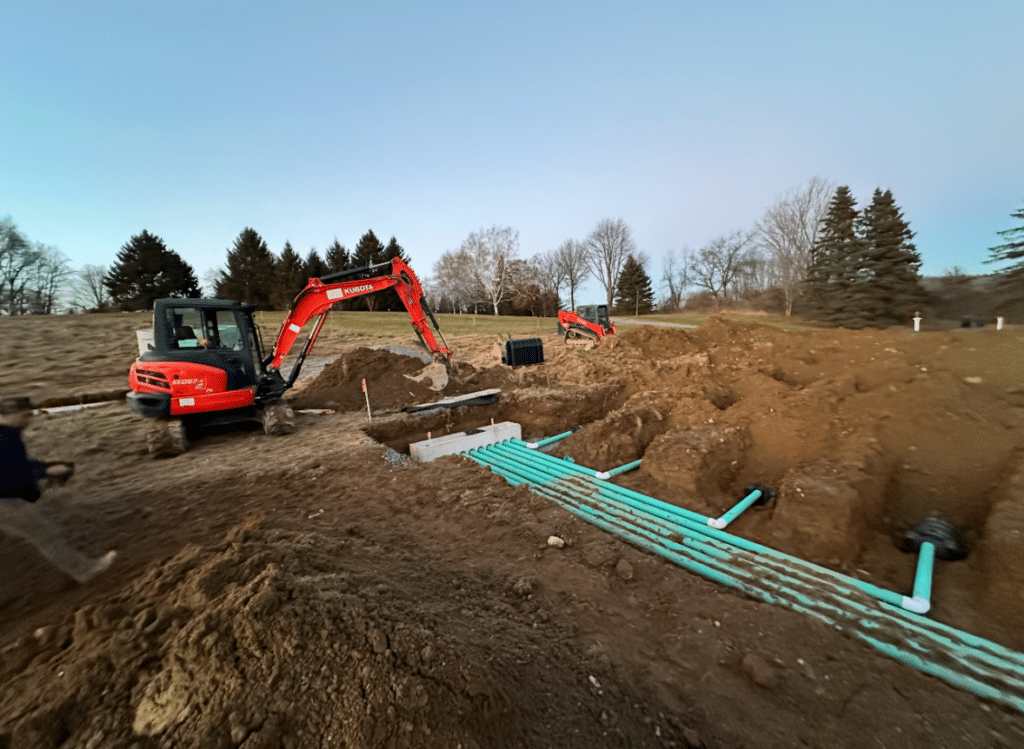
In tight mountain locations or sites with high water tables, combining custom interceptor drains with modern site preparation provides long-term protection against hydraulic overloads. Landowners planning replacement systems or field expansions can rely on professional excavation and trenching services to prepare slopes and dig trenches according to local code requirements.
External References
-
US Environmental Protection Agency (EPA) – Septic Systems Guidance
-
National Environmental Services Center (NESC) – Wastewater Resources
Key Takeaways
-
Begin with municipal research: Contact local health departments and environmental protection agencies to check for archived permits before digging up the yard.
-
Use non-invasive electronic tracing: Deploy flushable sondes, pipe cameras, and ground-penetrating radar to locate tanks and lines without causing major lawn damage.
-
Audit physical integrity: Inspect tank walls, baffles, and distribution boxes for chemical corrosion, structural cracking, or root damage.
-
Assess soil absorption: Run controlled hydraulic load tests to check percolation rates and catch early signs of biomat buildup.
-
File updated as-built records: Submit accurate site diagrams to local authorities to protect property values and simplify future maintenance.
-
Protect system components: Keep heavy vehicles off absorption fields, add insulation in cold zones, and maintain proper separation from private drinking wells.
Schedule Your Professional Septic Diagnostic Today
Navigating an unrecorded, unmapped septic system doesn’t have to put your property at risk. The experienced site specialists at Triple J Services bring field-proven diagnostic tools, high-resolution video equipment, and complete excavation capabilities to every job across Northeastern Pennsylvania and Northern New Jersey. Whether you need to locate an old tank, inspect a drain field, or update your site permits, our team delivers clear answers and lasting solutions. Call (845) 750-5222 today or visit Triple J Services to book your on-site system inspection.