Executive Summary / Fast Track Summary:
-
Mandatory Municipal Cycle: Pennsylvania’s Act 537 requires municipalities across Monroe County to enforce mandatory septic tank pumping and inspection cycles—typically every 3 years—to protect regional groundwater and fragile Pocono watersheds.
-
Severe Non-Compliance Penalties: Failure to report timely pumping or provide certified pumper manifest receipts to your local Sewage Enforcement Officer (SEO) results in official municipal violation notices, daily compounding fines, and forced emergency property inspections.
-
Soil & Cold-Weather Vulnerabilities: Monroe County’s heavy glacial till, high water tables, and severe winter freeze-thaw cycles accelerate biomass clogging and hydraulic overload if tanks are not regularly pumped and inspected.
-
Comprehensive Record Keeping: Compliant maintenance requires detailed pumper receipts outlining scum and sludge layers, baffle structural integrity, and tank volume, which must be retained for municipal audits and seamless property transactions.
Monroe County Septic Pumping Ordinances: Are You Compliant?
Imagine receiving an official notice of violation from your local township Sewage Enforcement Officer (SEO), accompanied by daily compounding fines, simply because a routine septic pumping receipt was never filed with the municipal office. For thousands of homeowners, short-term vacation rental (STR) operators, commercial property owners, and land developers in Monroe County, Pennsylvania, this scenario is an active reality. Local municipalities, backed by strict state environmental mandates, actively track and enforce mandatory on-lot sewage management programs. Pumping your septic tank is no longer just good preventive maintenance; it is a legally enforced municipal obligation.
Navigating the complex web of local township ordinances, Pennsylvania Department of Environmental Protection (PA DEP) mandates, and hard-rock mountain soil hydraulics can be daunting. Triple J Services provides complete municipal compliance, heavy-duty tank pumping, specialized drainage engineering, and full-scale excavation services across the Tri-State region.
1. Navigating Pennsylvania Act 537 and Monroe County Municipal Mandates
Core Answer: Pennsylvania’s Sewage Facilities Act (Act 537) mandates that every municipality maintain an official sewage management plan. In Monroe County, local townships enforce mandatory septic tank pumping schedules—typically every 3 years—requiring property owners to submit licensed pumper manifests directly to the municipal Sewage Enforcement Officer (SEO) to maintain legal compliance.
The PA Act 537 Compliance Lifecycle
Maintaining compliance with local wastewater ordinances involves a three-stage administrative process:
-
Township Pumping Notice Issued: The municipal Sewage Enforcement Officer generates an official notice based on your property’s assigned geographical phase or calendar cycle, alerting you that your triennial inspection window is open.
-
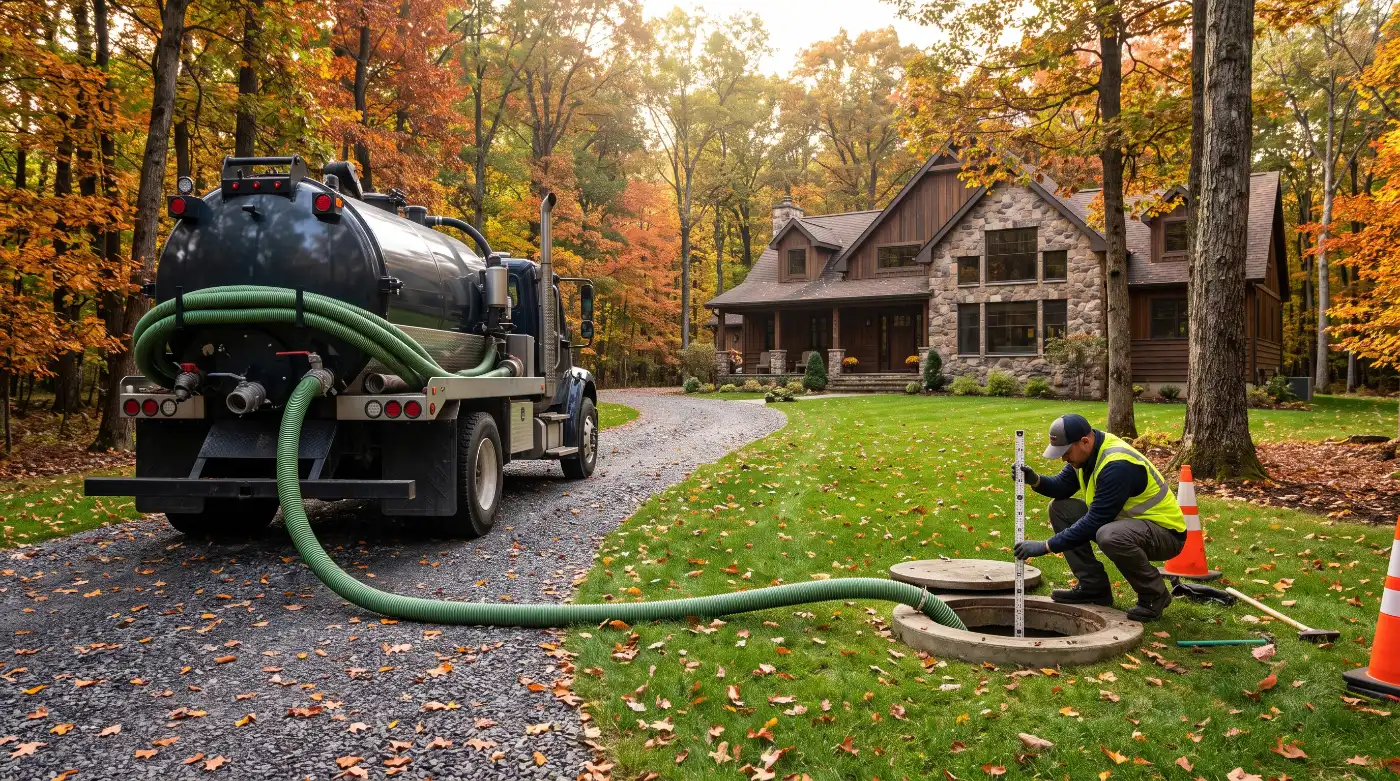
Licensed Pumping & Tank Inspection: A licensed wastewater contractor pumps the full volume of the tank, measures internal solids, checks baffle integrity, inspects liquid levels, and evaluates effluent filter status.
-
Manifest Submission & Certification: The contractor files an official, legally binding pumping manifest receipt directly with the municipal SEO, clearing the property from the municipal enforcement queue.
How Municipal Enforcement Works in Pennsylvania
Pennsylvania does not operate under a single, centralized statewide residential septic regulation. Instead, under PA DEP Act 537, regulatory authority is delegated directly to local municipalities. Townships across Monroe County—including Pocono, Stroud, Coolbaugh, Tobyhanna, Jackson, and Middle Smithfield—have established On-Lot Sewage Management Programs (OLSMP). These programs require property owners to pump their septic tanks on a strict rotational schedule (usually once every 3 years) and submit written proof from a registered pumper.
Townships divide their jurisdictions into geographic districts or phased calendar years. When your property’s assigned phase opens, the municipal office issues an official notice requiring a complete system pump-out and visual inspection. Hiring a contractor is only half the process; the pumper must complete an official manifest detailing tank volume, scum and sludge depth, baffle integrity, and overall mechanical condition. This document must be submitted directly to the local Sewage Enforcement Officer.
Ignoring an SEO notification leads to immediate administrative warnings, summary citations, daily monetary fines, and potential revocation of occupancy permits. Short-term vacation rentals in Pocono townships face double scrutiny. High occupant turnover rapidly accelerates sludge accumulation, causing sudden backups and municipal red flags during annual STR license renewals.
Hydraulic Overload in Pocono Glacial Till
Monroe County’s geological profile presents severe challenges for on-lot wastewater systems. The regional soil primarily consists of dense glacial till, heavy clay, and shallow bedrock resting over Pocono sandstone. These soil types possess extremely low percolation rates, meaning wastewater drains through the subsoil at a very slow pace.
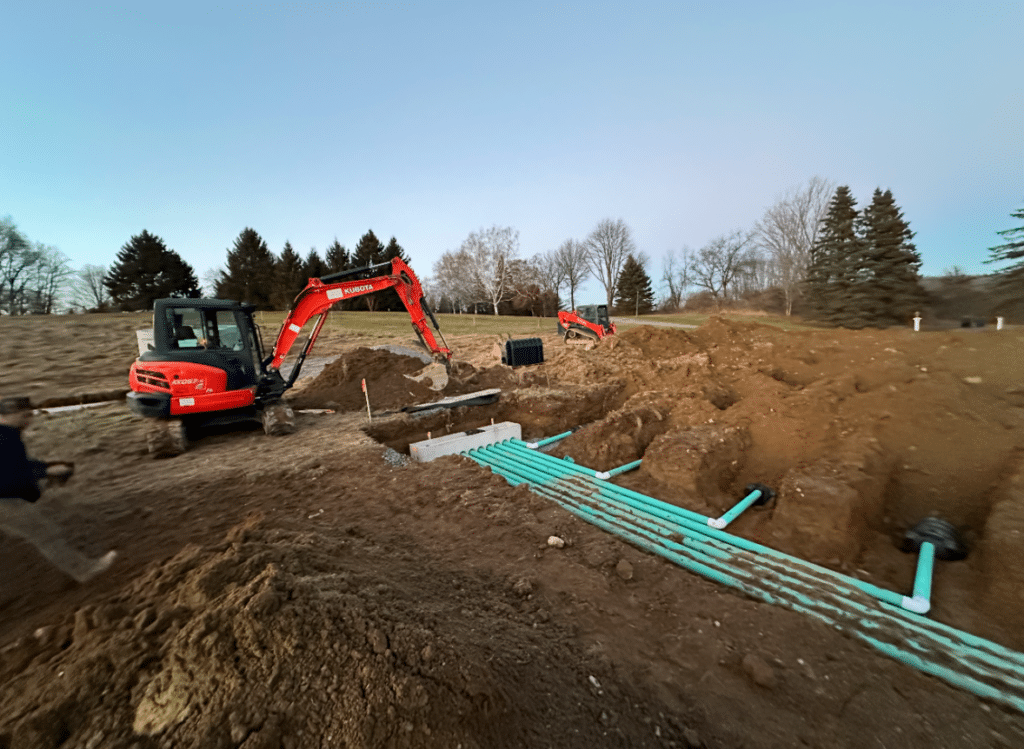
When a septic tank goes unpumped beyond its municipal window, suspended solids (sludge) spill past damaged outlet baffles directly into the distribution box and leach field. In clay-rich ground, this suspended organic material creates an impenetrable biomat layer. Combined with high seasonal water tables, hydraulic overload rapidly causes raw sewage to break through the surface or back up into lower-level building fixtures. Homeowners dealing with failing gravity drainfields or complex sand mounds can inspect our specialized Leach Field (“Turkey Mound”) Repair & Installationservices to restore structural absorption capacity.
Winter Freeze-Thaw Mechanics and Biomass Clogging
Winter weather in the Pocono Mountains accelerates structural septic failures. Sub-zero frost lines penetrate deep into clay soils, freezing uninsulated supply pipes, dosing tanks, and distribution boxes.
-
Ice Damming Under Snowpack: Heavy snowpack over a leach field acts as a temporary insulator, but if the soil beneath is already saturated from skipped pumping cycles, standing water freezes solid near the surface.
-
Suffocating Beneficial Bacteria: Freezing conditions combined with heavy biomass accumulation reduce the overall thermal retention of the tank. This starves essential anaerobic bacteria, stopping them from digesting waste solids and leading to rapid mechanical clogging.
-
Hydrostatic Pressure Spikes: During early spring thaws, melting snow saturates the surrounding subsoil. If a septic tank is filled with dense sludge, high hydrostatic pressure can push groundwater through cracked tank walls or dislodge underground distribution piping.
Property owners facing sudden freezing, severe line blockages, or emergency tank surcharges can rely on our Emergency Septic Pumping team to clear lines and prevent structural flooding.
2. Technical Inspection Standards, Mechanical Failure Points, and Long-Term Site Strategies
Core Answer: Compliant septic maintenance requires detailed structural inspections of tank baffles, effluent filters, and pump controls during every pumping cycle. Utilizing high-pressure hydro-jetting and maintaining essential pumping records prevents biomat blinding, extends absorption field lifespans, and guarantees full compliance with municipal SEO audits.
Structural Anatomy of a Compliant Septic Tank
A compliant septic system relies on two distinct structural zones inside the tank to manage solid-liquid separation and protect the downstream absorption field:
-
Inlet Zone Dynamics: The inlet pipe connects directly from the home into the first compartment of the tank, where a dedicated inlet baffle or sanitary tee directs raw wastewater downward. This prevents incoming turbulence from disturbing the floating scum layer and stops solid waste from clogging the main sewer line entering the tank.
-
Outlet Zone Dynamics: The outlet structure acts as the final line of defense before liquid effluent enters the drainfield. It utilizes an outlet baffle paired with an effluent filter to capture fine floating particles, preventing solid waste from escaping into the distribution box and destroying soil percolation pathways.
Critical Mechanical Failure Points
During a routine municipal pumping visit, field technicians must inspect several key mechanical components to prevent catastrophic system collapse. Skipping thorough structural checks leaves homeowners vulnerable to undetected mechanical breakdowns that simple pumping cannot resolve.
-
Outlet Baffles and Effluent Filters: The outlet baffle prevents floating scum from entering the absorption field. Age, hydrogen sulfide gas corrosion, or physical impact can break concrete or PVC baffles. Missing baffles allow solid waste to stream directly into the drainfield, causing permanent clogging. Effluent filters catch fine suspended solids and must be removed and cleaned during every pump-out.
-
Effluent and Grinder Pump Assembly: In elevated sand mound systems or deep uphill grades, effluent pumps or grinder pumps push wastewater to the treatment area. Failed float switches, burned-out motor impellers, or cracked check valves cause pump chambers to overflow, triggering alarm panels and forcing raw sewage back toward the structure.
-
Distribution Box (D-Box) Leveling: The distribution box evenly splits liquid effluent among leach field lateral pipes. Ground settling, frost heaving, or heavy machinery weight can tilt the D-box. This misaligns flow, overloading one trench while leaving others dry, which leads to premature soil blinding.
For properties utilizing pressurized distribution or uphill pump chambers, explore our specialized Effluent Pump Service & Replacement and Grinder Pump Repair & Installation to ensure reliable waste transport.
Comparing High-Pressure Hydro-Jetting vs. Standard Mechanical Snaking
When sewer lines slow down, choosing the correct clearing methodology determines whether the pipe is temporarily opened or fully restored:
-
Standard Cable Snaking Method: Standard snaking uses a spinning steel cable to puncture a hole through soft obstructions. While it breaks up immediate clogs, it leaves a heavy coating of grease, biological scale, and sludge along the inner pipe walls. This remaining debris acts as a magnet for new blockages, offering only a temporary fix.
-
High-Pressure Hydro-Jetting Method: Hydro-jetting utilizes specialized nozzles delivering water streams at 3,000 to 4,000 PSI to scour the entire inner circumference of the pipe wall. It strips away hardened grease, heavy biological slime, scale, and intrusive root masses, flushing the line entirely clean and restoring original hydraulic pipe capacity.
Using high-pressure jetting prior to severe winter freezes prevents standing water from settling and freezing inside main building drains and distribution laterals. Learn how our team restores clogged infrastructure by visiting our High-Pressure Drain Jetting (Hydro-Jetting) section.
Integrating Exterior Drainage & Hydrostatic Risk
Septic systems do not operate in isolation; they are deeply connected to surrounding site drainage and subsoil conditions. Heavy surface runoff from roof downspouts, driveway channels, or improper grading can flood leach fields and undermine foundation walls.
-
Curtain and French Drain Integration: Installing deep curtain drains or perimeter French drains intercepts shallow groundwater before it reaches the absorption field. Diverting upslope surface runoff reduces hydraulic load on the leach field, protecting soil percolation capacity.
-
Protecting Structural Footings: Uncontrolled subsurface water creates hydrostatic pressure against foundation walls. In freezing conditions, wet soils expand against concrete block footings, causing structural cracking and basement flooding.
Property managers and land developers seeking complete site water management can review our French Drains & Drainage Solutions and comprehensive Excavation & Utility Trenching solutions.
Technical Specifications & Compliance Reference
Understanding local regulatory standards helps maintain full compliance and long-term system functionality. The guidelines below detail regulatory expectations across Monroe County municipalities:
-
Standard Pumping Frequency: Mandatory once every 3 years for primary single-family residences. High-occupancy short-term vacation rentals (STRs) or commercial establishments with active kitchens require pumping every 1 to 2 years to offset accelerated sludge buildup.
-
Regulatory Oversight Body: Administered under PA DEP Act 537 through local municipal Sewage Enforcement Officers (SEOs).
-
Required Manifest Data Points: Official submissions must document total gallons pumped, scum and sludge layer thickness, inlet and outlet baffle structural conditions, visual evidence of surface breakout, and overall tank structural integrity.
-
Minimum Tank Sizing (PA DEP): Standard regulations require a minimum 900-gallon tank capacity for 1 to 3 bedroom single-family homes. Larger residences with 4 or more bedrooms or commercial properties require 1,000 to 1,500+ gallon multi-compartment tanks.
-
Primary Physical Failure Factors: Severe solid waste overflow caused by unpumped tanks, degraded concrete baffles, crushed or unlevel distribution boxes, winter line freezing, and excessive surface runoff saturating the absorption area.
-
Filing Timeline: The official pumper manifest receipt must be submitted directly to the township municipal building within 30 days of service completion to avoid administrative enforcement.
When buying, selling, or updating a residential or commercial property in Eastern Pennsylvania, visit our Septic System Inspections page to request a complete system evaluation and ensure your paperwork meets all municipal standards.
External References
-
Pennsylvania Department of Environmental Protection (PA DEP) – On-Lot Sewage Program: Official state regulatory guidelines, Act 537 standards, and technical engineering bulletins for on-lot wastewater treatment.
-
US Environmental Protection Agency (EPA) – SepticSmart Homeowner Guide: Comprehensive federal guidance on septic maintenance, system mechanics, and environmental protection protocols.
Key Takeaways
-
Strict Municipal Enforcement: Monroe County townships enforce mandatory 3-year septic pumping schedules under PA DEP Act 537. Missing your pumping window can result in summary fines and legal non-compliance.
-
Mandatory Manifest Filing: Pumping alone does not satisfy township requirements. A detailed inspection manifest must be submitted to your local Sewage Enforcement Officer (SEO).
-
Soil Vulnerability: Regional clay soils and heavy glacial till mean neglected tanks quickly lead to biomat clogging, hydraulic overload, and costly leach field failures.
-
Winter Protection: Extreme cold increases line freezing and pump failures. Regular maintenance, jetting, and baffle inspections safeguard your system during freeze-thaw cycles.
-
Total Water Strategy: Combine regular septic pumping with proper site drainage (such as French drains) to protect both your leach field and foundation footings.
Protect Your Property with Triple J Services
Navigating municipal regulations, preventing costly winter backups, and protecting your property’s infrastructure requires an experienced trade partner. At Triple J Services, our field technicians deliver advanced septic pumping, thorough structural inspections, hydro-jetting, and full-scale excavation solutions across Lackawaxen, Monroe County, and the Tri-State area. We ensure your system operates at peak performance while keeping your municipal compliance records completely up to date.
Don’t wait for a township citation or an unexpected sewage backup. Call the regional experts at Triple J Services today at (845) 750-5222 or visit Triple J Services Online to schedule your municipal compliance pump-out and inspection.