
Fast Track Summary
-
Overcoming Pocono Topography: Effluent pumps lift clarified wastewater from septic tanks up to higher-elevation leach fields or elevated sand mounds when natural gravity flow is physically impossible due to steep slopes or shallow bedrock.
-
Protecting Absorption Zones: Unlike sewage grinder pumps that handle raw solids, effluent pumps handle pre-filtered liquid waste, utilizing high-head pressure to distribute effluent evenly across absorption fields.
-
Winter Risk Mitigation: Freeze-thaw cycles, shallow frost lines, and heavy snowpack in Wayne, Pike, and Monroe Counties can cause hydraulic overload or frozen force mains without proper check valves, thermal insulation, and anti-siphon protection.
-
Proactive Site Engineering: Regular mechanical inspections, proper float switch calibration, and high-pressure line maintenance prevent catastrophic backup into basements and premature soil absorption bed failure.
A homeowner in Lake Wallenpaupack wakes up on a sub-zero January morning to a screeching high-water alarm in their basement utility closet. Outside, two feet of dense snow covers a steep slope leading up to an elevated sand mound, while beneath the surface, thousands of gallons of wastewater sit trapped in a precast concrete tank. Without a fully functional pumping system, that wastewater has nowhere to go but back up through the lowest household drains, threatening thousands of dollars in property damage.
What Is an Effluent Pump and How Does It Function in Pocono Mountain Septic Systems?
An effluent pump is a specialized submersible mechanical pump designed to lift clarified liquid wastewater out of a septic tank or dosing chamber and transport it under pressure to an elevated or remote absorption area, such as a leach field or elevated sand mound. Unlike gravity-fed systems that rely strictly on downhill slopes, an effluent pump uses dynamic head pressure to push filtered wastewater uphill, through tight force mains, and across rocky or steep Pocono terrain.
The Mechanics of Effluent Transport and Hydraulic Head
Effluent pumps operate in the secondary stage of a decentralized wastewater treatment system. Primary treatment occurs inside the main septic tank, where heavier solids settle to the bottom as sludge and lighter oils float to the top as scum. The clarified liquid layer in the middle—known as effluent—flows through an outlet filter into a secondary pump tank or dedicated dosing chamber.
Wastewater follows a strict four-stage path from your household plumbing to its final environmental absorption:
-
Household Discharge: Raw wastewater exits household fixtures through the primary sewer line and enters the main septic tank.
-
Primary Mechanical Separation: Heavy organic solids settle to the bottom as sludge, oils float to form a scum layer, and clarified liquid remains in the center.
-
Filter Transfer to Dosing Chamber: Clarified liquid flows through an outlet baffle filter into a dedicated secondary dosing chamber containing the submersible effluent pump.
-
Pressurized Delivery to Absorption Bed: When the liquid level triggers the float switch, the pump activates, driving effluent through a solid PVC force main line up to the elevated sand mound or pressure-dosed leach field.
When liquid in the dosing chamber reaches a predetermined elevation, a tethered or vertical mechanical float switch closes the electrical circuit, activating the pump motor. The pump draws in filtered liquid and pushes it through a solid PVC force main directly into the absorption area.
-
Solids Handling Capacity: Effluent pumps are engineered to pass spherical solids up to 1/2-inch to 3/4-inch in diameter. They are distinctly different from standard sump pumps (which handle clear groundwater) and raw sewage grinder pumps (which shred large, solid waste directly from household toilets).
-
Total Dynamic Head (TDH): This represents the total equivalent height the pump must push fluid, combining vertical elevation lift with friction loss inside the pipe walls. In mountainous regional terrain, high-head pumps are required to overcome vertical climbs exceeding 30 feet.
-
Dosing Volume Precision: Unlike gravity systems that constantly trickle small amounts of liquid into the soil, effluent pumps deliver controlled, high-volume doses. This cyclical dosing forces liquid evenly across the entire absorption footprint, allowing soil micro-organisms time to process pathogens between doses.
Environmental Constraints: Bedrock, Clay, and Slope Factors
Topography across Northeastern Pennsylvania—particularly throughout Wayne, Pike, and Monroe Counties—presents severe natural obstacles to traditional gravity-fed drainfields. Glacial till deposits leave thick layers of tight clay soils over shallow sandstone and shale bedrock, drastically reducing natural soil percolation rates.
In lower-lying areas near lakes, ponds, and river basins, high seasonal water tables push groundwater within inches of the ground surface during spring thaws. Pennsylvania Department of Environmental Protection (PA DEP) regulations require a minimum vertical separation distance between the bottom of an absorption trench and the seasonal high water table or rock ledge. When site soil fails percolation testing or hits solid rock early, gravity flow is ruled out.
An elevated sand mound system overcomes these restrictive subsoil layers through a carefully engineered structure:
-
Pressurized Distribution Lateral Pipes: Perforated PVC pipes receive high-pressure effluent doses from the pump, distributing liquid evenly across the mound.
-
Permeable Sand Layer: A deep layer of clean, washed mound sand acts as the primary filtration medium, treating pathogens as liquid percolates downward.
-
Aggregate and Native Soil Bed: The base layer allows final biological absorption into native topsoil above hard bedrock or high water tables.
-
Restricted Subsoil Zone: Shallow sandstone ledge or tight clay hardpan blocks natural gravity flow, making the above-grade sand mound mandatory.
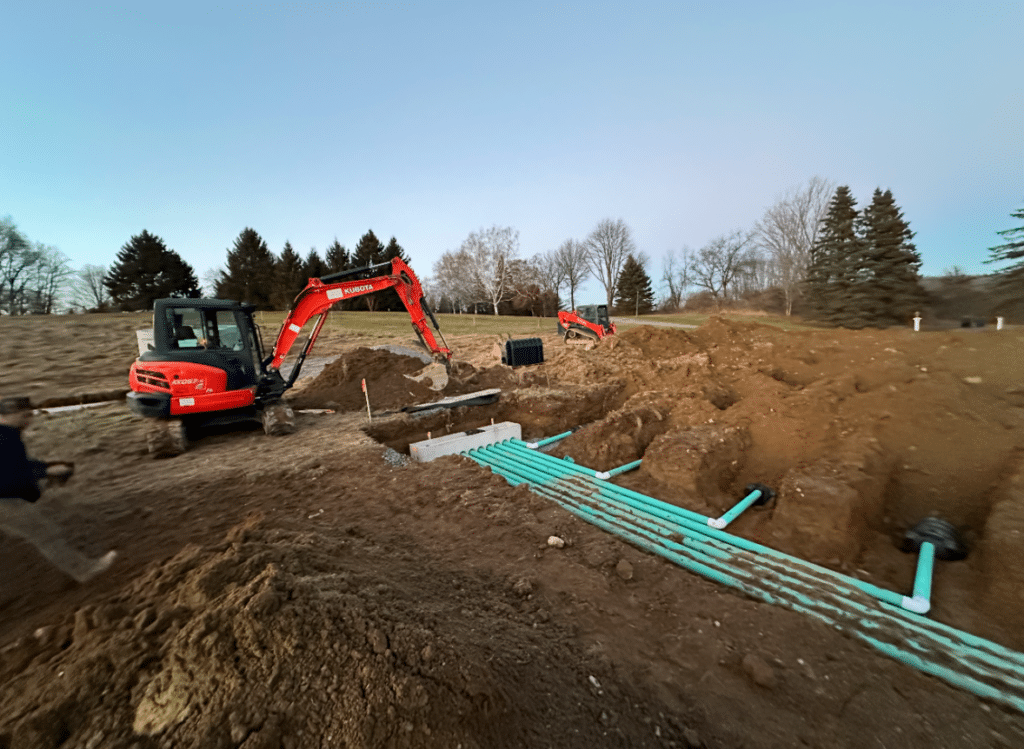
Under these strict environmental rules, installation of an elevated sand mound (commonly referred to locally as a “Turkey Mound”) becomes necessary. Because the sand mound is built above native grade to create an artificial filtration zone, the wastewater must be pumped up into it. Installing a custom system tailored to tough terrain requires specialized site engineering and dedicated excavation and utility trenching to cut force main lines deep beneath local frost depths.
Effluent Pumps vs. Grinder Pumps and Sump Pumps
Homeowners frequently confuse the mechanical equipment inside their utility rooms or yards. Each pump type serves an entirely different purpose, and swapping them leads to swift mechanical failure.
-
Effluent Pumps vs. Sump Pumps: Sump pumps manage clear, non-potable groundwater from around foundation footings to relieve hydrostatic pressure. They feature lighter-duty motors not built to withstand the corrosive, acidic nature or suspended fine solids present in septic wastewater.
-
Effluent Pumps vs. Grinder Pumps: Grinder pumps use high-speed rotating cutter blades to shred raw sewage containing large solids, toilet paper, and debris before pumping it into municipal sewer mains or septic tanks. Effluent pumps never handle raw sewage; they receive liquid that has already undergone primary settling inside a septic tank. Using an effluent pump on raw, unsettled sewage instantly jams the impeller and burns out the motor windings. When pumps fail or lift stations stall, specialized effluent pump service and replacement or rapid grinder pump repair and installation is required to prevent immediate sewage back-ups into the home.
The operational differences between effluent pumps and sewage grinder pumps center on liquid composition, internal components, and placement:
-
Fluid Type: Effluent pumps handle clarified liquid wastewater, while sewage grinder pumps process raw, unsettled wastewater directly from fixtures.
-
Solid Handling Capacity: Effluent pumps pass fine particles measuring 1/2 inch to 3/4 inch, whereas grinder pumps grind and shred large solids and debris before pumping.
-
System Placement: Effluent pumps sit inside a secondary dosing chamber after primary settling, while grinder pumps sit in a basin handling raw, unsorted waste.
-
Core Purpose: Effluent pumps lift pre-filtered water uphill into absorption beds, whereas grinder pumps macerate heavy solids to force waste through long municipal force mains.
A common seasonal mistake involves running household water continuously during extreme cold snaps to prevent indoor pipes from freezing. While this protects indoor plumbing, it floods the septic dosing chamber with thousands of extra gallons of water. This hydraulic overload causes the effluent pump to cycle continuously without resting, overheating the motor and short-lived electrical relays.
Why Are Effluent Pumps Essential for Pocono Mountain and Tri-State Properties?
Effluent pumps are essential in the Pocono Mountains and Tri-State region because steep mountain topography, shallow bedrock, and dense clay soils prevent natural gravity drainage. These specialized pumps force clarified wastewater uphill into elevated sand mounds or engineered leach fields, protecting groundwater supplies and preventing hazardous wastewater ponding on rocky terrain.
Tackling Regional Geology and Sub-Surface Hydraulic Challenges
The geological footprint of the Pocono Mountains and Northern New Jersey was carved by glacial movement, leaving behind dense, poorly draining subsoil layers like hardpan clay mixed with loose cobbles. In locations with rocky outcroppings or dense hardpan, water cannot filter downward at the rate required by state environmental standards.
To manage high elevations and difficult mountain terrain, wastewater flow must be mechanically directed across varying site levels:
-
Low-Elevation Collection: Wastewater flows down from home foundation drains into a primary septic tank positioned in accessible, lower-lying terrain.
-
Intermediate Clarification: Settled liquid moves into the adjacent pump chamber, preparing for high-pressure transfer.
-
Pumping Uphill: The submersible effluent pump forces liquid up through a buried force main, driving it up steep mountain slopes.
-
High-Elevation Absorption: Effluent reaches the elevated sand mound or engineered leach field located in suitable upper-elevation soil.
When gravity cannot deliver effluent to a suitable absorption bed, engineered force mains bridge the distance. The pump creates sufficient scouring velocity—typically at least 2 feet per second inside the discharge pipe—to keep fine suspended particles moving through the line without settling out and causing internal clogs.
-
Managing Slope Variations: Mountainous home sites often place the residence at a lower elevation than the designated primary or reserve absorption area. Effluent pumps overcome gravity, pushing fluid up steep grades without leaking or stalling.
-
Preventing Hydraulic Saturated Soil Failure: Pumping effluent in controlled, uniform doses prevents the soil interface from remaining constantly submerged. Continuous saturation creates a thick, impenetrable layer of anaerobic bacterial slime known as a biomat, which permanently seals off soil pores and destroys leach fields.
-
Protecting Private Well Head Water: Tri-State rural properties rely almost exclusively on private, deep-drilled groundwater wells. Pumping effluent to a properly engineered, elevated treatment bed ensures effluent filters through yards of sand and natural soil before reaching underground aquifers, safeguarding drinking water.
Property managers handling multi-family rentals or commercial spaces often face winter drainage failures when heavy snowmelt overwhelms site drainage. Installing dedicated surface collection solutions like French drains and drainage solutions around elevated mound sites prevents surface runoff from saturating absorption beds from above, allowing the effluent pump to discharge safely into unsaturated ground.
Winter Operating Conditions and Thermal Dynamics
Winter across Wayne, Pike, and Monroe Counties brings extended sub-zero temperature spells that drive frost deep into the soil. According to cold-climate data from the National Weather Service, frost penetration in exposed Northeastern PA ground can easily exceed 36 to 48 inches during dry, snowless freeze events.
Cold-weather conditions demand precise engineering to manage thermal loss across underground septic layers:
-
Snowpack Insulation Layer: A natural, undisturbed blanket of deep snow traps ambient ground heat, preventing frost from driving deep into absorption beds.
-
Deep Frost Line Zone: Uninsulated soil freezing down 36 to 48 inches causes extreme ground thermal conduction, threatening exposed pipes.
-
Pitched Force Main Pipelines: Correctly sloped discharge lines ensure residual liquid drains back into the tank after a dosing cycle rather than sitting above the frost line.
-
Submerged Pump Thermal Chamber: Wastewater entering the chamber at approximately 50°F creates a warm thermal buffer that protects submerged pump components.
Thermal dynamics play a major role in keeping an effluent pump operating safely in winter. Raw wastewater entering the system from showers, dishwashers, and laundry carries a base temperature of roughly 50°F to 60°F. This thermal energy creates a warm microclimate inside buried concrete septic tanks and dosing chambers.
-
Force Main Drainage Pitch: After an effluent pump completes its pumping cycle, any liquid remaining in an uninsulated pipe above the local frost line will freeze solid, shattering the pipe. Systems must be engineered so that effluent inside the vertical rise drains back into the pump chamber, or flows completely into the mound using a self-draining weep hole located below the frost line.
-
Check Valve Freeze Points: A check valve prevents pumped liquid from flowing backward into the dosing tank. If an installer incorrectly places the check valve above the frost line outdoors, standing water trapped above the valve stem will freeze solid, blocking all future pump discharges.
-
Snowpack Thermal Insulation Trade-off: Dense snowpack acts as a natural insulating blanket over a leach field or sand mound, trapping ambient ground heat. However, driving heavy machinery, snowmobiles, or ATVs over the disposal area compacts the snow, destroying its insulating air pockets and pushing frost deep into distribution pipes.
Property owners facing severe winter line freezes or solid blockages rely on targeted high-pressure drain jetting (hydro-jetting) to blast through frozen sludge and ice dams without cracking subterranean PVC piping.
Essential Components, Mechanical Failure Points, and Prevention
An effluent pumping assembly is an interconnected mechanical system where the failure of one low-cost component can disable the entire septic infrastructure. Understanding the key failure points helps property owners catch issues before catastrophic backups occur.
The mechanical control assembly within a dosing chamber relies on a coordinated sequence of components:
-
Indoor Control Panel and Alarm: Mounted inside the utility room or on an exterior wall, wired to the main breaker to give visual and audible alerts.
-
High-Water Alarm Float Switch: Positioned above the normal operating range; triggers the control panel alarm if liquid rises past safe operational thresholds.
-
Pump Operating Float Switches: Calibrated “ON” and “OFF” floats that automatically regulate pump cycles based on liquid elevation.
-
Check Valve and Discharge Assembly: Positioned below local frost depth inside the riser pipe, allowing one-way fluid flow to the absorption bed while preventing backflow.
-
Submerged Effluent Pump: Heavy-duty motor unit sitting at the bottom of the dosing chamber, pushing liquid upward through the discharge pipe.
The float switch is the most common mechanical point of failure. Tethered mechanical floats switch the pump motor on and off as water levels rise and fall. Over time, grease, biological scum, or floating debris coat the float casing, weighting it down or wedging it against the chamber wall.
-
Float Switch Degradation: A stuck “ON” float runs the pump dry, burning out its water-cooled motor seals. A stuck “OFF” float allows the chamber to fill completely, triggering high-water alarms and flooding indoor drains.
-
Effluent Filter Clogging: Septic tank outlet filters capture suspended solids before they enter the pump chamber. If homeowners neglect regular filter maintenance, the filter clogs completely, starving the pump chamber of water and causing the pump to run dry or cycle erratically.
-
Capacitor and Relay Failures: Control panels installed outdoors encounter extreme humidity and freeze-thaw cycles. Electrical contacts pit, relays corrode, and start capacitors fail, preventing the pump motor from drawing initial electrical power.
Understanding key components, their failure modes, and preventive strategies ensures long-term system reliability:
-
Mechanical Float Switches: Fail due to grease buildup or physical snagging; prevented by semi-annual cleaning, tether alignment checks, and casing wash-downs.
-
Check Valves: Fail when debris wedges in the hinge or standing water freezes above the stem; prevented by below-frost installation and routine pressure checks.
-
Effluent Filters: Fail from biomass buildup and fine solid accumulation; prevented by annual wash-downs and scheduled professional inspections.
-
Force Main Piping: Fails through freeze-expansion cracking and stress fractures; prevented by self-draining weep holes, proper slope pitch, and insulation.
A common misconception among mountain homeowners is that adding store-bought chemical or bacterial additives will clean effluent filters and eliminate the need to pump the tank. In reality, chemical additives break down settled solids prematurely into fine suspended fats that pass straight through septic filters, clogging force main laterals and smothering the receiving soil bed.
When system alarms sound or high water levels persist, getting a comprehensive septic system inspection pinpoints whether the issue lies in electrical control relays, mechanical impellers, or cracked piping. If an unmaintained tank experiences severe solids carryover that bypasses the filter, emergency leach field (“turkey mound”) repair and installation or rapid emergency septic pumping becomes necessary to restore hydraulic balance to the property.
According to guidance from the U.S. Environmental Protection Agency (EPA), regular inspections and timely mechanical maintenance remain the single most effective way to protect groundwater quality and prevent costly secondary site repairs.
External References
-
U.S. Environmental Protection Agency (EPA) – Septic Systems: https://www.epa.gov/septic
-
National Weather Service (NWS) – Winter Safety & Frost Data: https://www.weather.gov/
Key Takeaways
-
Match Pump Design to System Architecture: Always install a purpose-built effluent pump for clarified wastewater, never a groundwater sump pump or raw sewage grinder pump.
-
Protect Components from Deep Frost: Ensure force mains feature self-draining weep holes and check valves are situated below local frost depth lines (36″-48″) to prevent ice blockages.
-
Maintain Outlet Filters Annually: Clean the septic tank effluent filter every 6 to 12 months to prevent solids carryover from entering the dosing tank and burning out pump seals.
-
Never Compact Snow Over Absorption Beds: Keep snowmobiles, ATVs, and heavy vehicles off sand mounds and leach fields to preserve snow insulation and prevent frozen lateral pipes.
-
Respond Immediately to Alarms: Treat high-water control panel alarms as urgent events; minimize indoor water usage immediately to prevent basement backups.
Professional Site Solutions
When managing complex site slopes, high groundwater, or cold-weather wastewater challenges in the Pocono Mountains and Tri-State area, expert engineering makes all the difference. Triple J Services delivers complete site service solutions—from advanced effluent pump diagnostics and hydro-jetting to complete excavation, mound installations, and emergency septic interventions.
To schedule a site assessment or resolve an urgent septic issue, call Triple J Services today at (845) 750-5222 or visit Triple J Services to speak directly with an expert specialist.