
Executive Summary / Fast Track Summary
-
SEO Officer Jurisdiction: Septic repair permitting in Pike County, PA is governed strictly by municipal Sewage Enforcement Officers (SEOs) enforcing Pennsylvania Code Title 25, Chapter 73 under PA DEP oversight.
-
Site Testing Mandatory: A failed absorption area or malfunctioning sand mound cannot be repaired on a whim; repairs require site soil probes, percolation testing, and formal design plan submittals.
-
Component-Specific Permits: Minor mechanical component swaps (like an effluent pump or alarm float) follow streamlined paths, while full absorption field reconstructions require engineered design approvals before ground breaking.
-
Integrated Site Logistics: Soil compaction, freezing frost line depths down to 36-48 inches in the Pocono Mountains, and hydrostatic surface runoff directly dictate design parameters and installation windows.
How to Apply for a Septic Repair Permit in Pike County PA
Applying for a septic repair permit in Pike County, Pennsylvania requires navigating state environmental mandates, township-specific administration, and the harsh physical realities of Pocono mountain geology.
When raw sewage backups saturate a residential yard in Milford or a distribution box collapses under a heavily wooded lot in Lackawaxen, property owners often assume a local contractor can simply roll an excavator onto the lot and dig a new trench. Proceeding without an official permit issued by your municipality’s licensed Sewage Enforcement Officer (SEO) violates Pennsylvania Code Title 25 (Chapter 73) and can result in severe municipal fines, forced project teardowns, and unmarketable property titles. Securing a septic repair permit in Pike County involves completing deep soil probes, performing percolation tests, submitting engineered system designs, and executing carefully timed site excavations that respect regional frost line dynamics.
The permitting process follows a clear, sequential path from the initial emergency response to final inspection sign-off:
-
Emergency Response and Notification: The property owner contacts both the municipal SEO and a qualified site specialist like Triple J Services to report the system malfunction and prevent environmental contamination.
-
On-Site SEO Evaluation: The SEO conducts a site assessment, witnessing deep soil probes and percolation testing to analyze subsoil absorption capacity.
-
System Design and Permit Application: A certified designer or professional engineer drafts repair specifications that adhere to PA DEP regulations and submits the formal permit application to the township.
-
Permitted Repair Excavation and Inspection: Licensed contractors execute the site excavation exactly to design specs, culminating in a mandatory open-site final inspection by the SEO before backfilling.
Navigating Pike County Septic Permit Regulations and SEO Jurisdiction
To successfully obtain a septic repair permit in Pike County, Pennsylvania, you must file a formal application through your local township’s appointed Sewage Enforcement Officer, undergo mandatory site soil testing, and submit a compliant repair design that meets Pennsylvania Department of Environmental Protection standards.
Pike County does not maintain a single centralized county-wide plumbing department that issues septic permits over a counter. Instead, jurisdiction is held at the municipal level across Pike County’s 13 townships and boroughs, including Dingman, Lehman, Delaware, Greene, and Palmyra townships. Every municipality hires or retains an SEO certified by the Pennsylvania Department of Environmental Protection (PA DEP). The SEO acts as the sole regulatory agent empowered to evaluate site conditions, witness soil testing, issue Pennsylvania Sewage Facilities Act (Act 537) permits, and perform final installation inspections.
The permitting journey begins when an owner or site manager identifies system failure—evidenced by surfacing effluent, sluggish indoor drains, or a high-water alarm activation. You must immediately contact both your township SEO and a licensed site specialist like Triple J Services. The SEO conducts an initial site verification to confirm the malfunction. Depending on whether the issue is a mechanical failure (such as a burned-out pump) or an absorption area failure, the permitting workflow diverges into two distinct categories.
-
Minor Component Repair Permits: Replacing a broken solid transfer pipe, swapping out a failed check valve, or installing a new electrical control panel typically qualifies for an expedited repair permit or administrative authorization, requiring minimal site testing.
-
Major Absorption Area Permits: Rebuilding a clogged trench system, converting a failed gravity bed into an elevated sand mound, or relocating an absorption field requires deep soil pit probes, percolation testing, and formal design plans drawn up by a professional engineer or qualified designer.
-
Emergency Repair Authorizations: In severe cases where untreated sewage enters surface waters or threatens structural foundations, the SEO can issue a temporary emergency authorization allowing containment pumping and preliminary site prep while formal design paperwork is compiled.
-
Component Standardization Checks: Upgrading old, undersized 750-gallon single-compartment concrete tanks to modern double-compartment tanks fitted with effluent filters requires specific tank replacement permitting and SEO sign-off prior to backfilling.
Understanding regional soil mechanics is essential during the permitting phase. Pike County soils, dominated by glacial till, dense hardpan, and shallow sandstone bedrock, present severe hydraulic challenges. A major trade misconception is that replacing a failed drain field simply requires digging out the old stone and dumping in fresh aggregate. In reality, once a leach field experiences severe biomass clogging (a rubbery biomat layer formed by long-term organic overloading), the underlying soil interface is permanently compromised. The SEO will require new deep probe testing—typically two 6-to-10-foot pits excavated by a backhoe—to evaluate the seasonal high water table and bedrock depth.
If the site displays mottling (reddish-brown or gray spots in the soil indicating periodic water saturation) within 20 inches of the surface, a standard in-ground pipe-and-stone field will be rejected by the SEO under Chapter 73 regulations. In these conditions, the permit will mandate an elevated sand mound (often locally termed a “Turkey Mound”). An elevated sand mound consists of several engineered layers built above the unexcavated native soil:
-
Vegetative Topsoil Layer: A protective top layer of permeable topsoil seeded with grass to shed rainwater and prevent erosion.
-
Engineered Concrete Sand Layer: A clean, coarse sand bed (minimum 1-foot thickness) that provides primary biological filtration and wastewater treatment.
-
Perforated Distribution Network: Rigid PVC distribution pipes set within clean washed aggregate that evenly distribute septic tank effluent across the sand bed.
-
Plow-Scarified Soil Interface: The native soil surface below the mound, carefully scarified with chisel plows to preserve soil macropores without compacting the ground.
-
Subsurface Mottling and Bedrock Zone: The native soil profile, seasonal high water table, or bedrock layer lying safely beneath the sand barrier to absorb treated effluent.
When designing elevated sand mounds, an overlooked structural risk involves soil compaction during site testing and site excavation. Heavy excavators driven across the proposed absorption footprint destroy the natural soil macropores required for water infiltration. To prevent permit revocation during the SEO’s pre-construction check, heavy equipment must remain strictly outside the down-slope absorption area. Furthermore, the permit design must account for spatial setbacks mandated by PA DEP, enforcing strict minimum distances from surrounding features:
-
Property Line Clearances: A minimum distance of 10 feet must be maintained between any component of the absorption field and neighboring property boundaries.
-
Groundwater Wellhead Protection: A mandatory 100-foot separation distance is required between private drinking water wells and the absorption area to prevent groundwater contamination.
-
Surface Water and Swale Buffer: A minimum buffer of 50 feet must separate the drain field from surface waters, streams, ponds, or drainage swales.
Property managers operating multi-family complexes or commercial facilities in northern New Jersey and Northeastern PA face additional hydraulic considerations. When applying for repairs on high-flow commercial systems, the SEO and state environmental authorities evaluate peak hydraulic surge capacity rather than daily average flow. High-pressure drain jetting is frequently utilized as a pre-diagnostic step to clear main line blockages and verify structural pipe integrity before finalizing the permit application scope.
To maintain compliance and avoid project delays, property owners should review the complete array of professional excavation, pump service, and site engineering options available through Triple J Services main offerings.
Executing Permitted Septic Repairs and Managing Site Dynamics
Executing a permitted septic repair in Northeastern Pennsylvania requires strict adherence to approved engineering plans, precise excavation methods, and mitigation of extreme weather hazards like winter frost lines and heavy surface runoff.
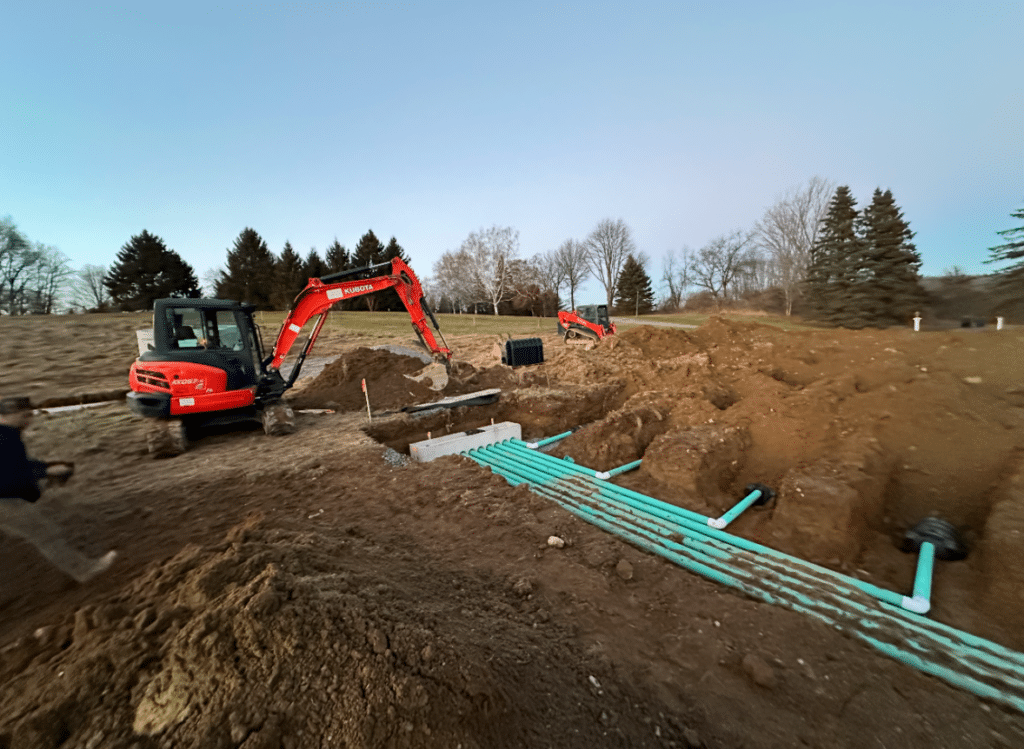
Once the township Sewage Enforcement Officer issues the official permit, the excavation phase must follow the explicit specifications detailed in the permit document. Deviating from the depth of stone, pipe slope, or aggregate gradation invalidates the permit and halts the project during mandatory SEO milestone inspections. Site preparation involves careful coordination of heavy machinery, material deliveries, and environmental controls.
In the mountainous terrain of Pike, Wayne, and Monroe counties, thermal conductivity and frost dynamics dictate installation timelines. Winter frost line depths in this region routinely penetrate 36 to 48 inches below the surface, particularly under unplowed or cleared soil. Executing permitted excavations during freezing weather introduces significant structural risks that must be managed by an experienced site specialist.
-
Preventing Frozen Absorption Beds: Excavating an absorption bed in sub-freezing temperatures exposes native subsoils to frost. If sand or aggregate is laid over frozen soil, the ground acts as an impermeable barrier when thawed, sealing the soil pores and causing immediate hydraulic failure upon system startup.
-
Thermal Insulation Techniques: Permits executed in late autumn or early winter often specify temporary straw or hay insulation blankets placed over open soil probes and freshly cleared absorption beds to preserve ambient soil heat before aggregate placement.
-
Pump Chamber Check Valve Protection: High-head submersible effluent pumps installed in dosing tanks must have their check valves set below the local frost line, or utilize an engineered weep hole mechanism within the vertical discharge pipe to allow liquid to drain back, preventing pipe bursts.
-
Curtain Drain Interception: To protect a newly permitted leach field from subsurface lateral water movement on sloped mountain properties, designers frequently incorporate perimeter French drains or curtain drains to redirect perched water tables away from the septic field.
A properly engineered curtain drain or French drain manages upslope groundwater runoff through a series of layered, high-permeability materials:
-
Surface Backfill Layer: Compacted topsoil graded to direct surface runoff away from the trench opening.
-
Coarse Aggregate Fill: Clean, coarse stone backfill that provides a low-resistance path for subsurface water movement.
-
Geotextile-Wrapped Pipe: A perforated drainage pipe wrapped in non-woven geotextile fabric to catch subsurface water while filtering out fine silt particles.
-
Impermeable Base Interface: The base of the trench cut directly into dense clay or bedrock, ensuring all lateral water is captured and diverted safely around the septic absorption area.
Site preparation on sloped land requires careful balancing of hydraulic loading and slope stability. When heavy rain or rapid snowmelt occurs, unmanaged runoff over fresh backfill can strip topsoil and wash away mound berms. Implementing professional surface water management strategies, such as slope grading and interceptor swales, is critical during the excavation window. Property owners experiencing severe groundwater intrusion near their foundations or septic components can explore Triple J Services French drain solutions to safeguard their site structure.
A common structural failure during repair execution involves improper pipe bedding and backfilling around newly set septic tanks or pump chambers. When an old, leaking concrete tank is pulled from the ground, the native excavation pit often contains soft, disturbed soil or high-moisture clay. Setting a new 1,500-gallon precast concrete tank directly onto soft earth causes differential settling over time. As the heavy tank sinks, it shears the rigid 4-inch PVC inlet and outlet lines at the tank wall penetrations. Site engineers specify a compacted 6-to-12-inch base of crushed stone (PA #2A or clean #57 aggregate) to provide a stable, level platform that resists movement under varying hydrostatic pressure levels.
For properties relying on pressurized dosing or elevated sand mounds, mechanical integration is just as vital as soil preparation. Effluent pumps must be sized according to dynamic head loss, taking into account vertical lift, pipe friction, and lateral pressure requirements. Installing an undersized pump to save upfront costs leads to short-cycling, motor burnout, and uneven effluent distribution across the sand mound. Conversely, an oversized pump can blow out distribution pipe caps or force liquid through the sand bed too rapidly, bypassing biological treatment processes.
A complete dosing tank and pump system relies on several integrated mechanical and structural components:
-
Control Panel and High-Water Alarm: An exterior-rated electrical enclosure that monitors pump cycles, controls run times, and alerts the owner to high water levels.
-
High-Level Alarm Float: An emergency float switch set above the normal operating range that triggers visual and audible alarms if the pump fails.
-
Pump Control Floats: Adjustable tethered float switches that dictate the precise liquid levels for turning the effluent pump on and off.
-
Submersible Effluent Pump and Check Valve: A heavy-duty pump engineered to discharge effluent through a check valve and force main set below the frost line directly to the distribution network.
-
Compacted Stone Tank Base: A firm foundation of compacted PA #57 aggregate supporting the dosing chamber to prevent shifting and pipe shear.
When managing complex pump systems, commercial sites or multi-level residential layouts frequently require specialized pumping hardware. Property managers can review advanced pump replacement strategies by reading about Triple J Services effluent pump replacement options.
When low-lying residential properties experience severe power outages, flooding, or mechanical failures during winter storms, immediate intervention is necessary to prevent sewage from backing up into living spaces. Under these conditions, coordinating emergency pumping clears excess liquid, giving the SEO and site team the window needed to assess structural pipe damage and process formal repair permits. If you face a sudden system overflow or backup, consult Triple J Services emergency pumping resources to stabilize the property.
Diagnosing mechanical failures in a dosing system follows a methodical troubleshooting procedure:
-
Alarm Activation: The high-water alarm sounds or indoor fixtures begin draining slowly, signalling a fluid accumulation inside the dosing tank.
-
Breaker Inspection: The technician inspects the main electrical panel and control box breakers to verify power delivery to the system.
-
Power Verification Branch: If electrical power is functional, the technician tests float switches and measures pump motor resistance. If power is tripped, the technician resets the breaker and measures electrical draw in amperes to identify short circuits or motor lockups.
-
Targeted Repair and Permitting: Once a failed pump or burnt-out motor is confirmed, site specialists dispatch appropriate replacement hardware and submit necessary component repair documentation to the local SEO.
Once the repair installation is finished, the SEO performs a final open-site inspection prior to backfilling. The contractor must pressure-test force mains, demonstrate pump operation, verify lateral squirt heights on pressurized fields, and confirm proper slope on gravity lines (typically 1/4 inch fall per foot for 4-inch pipe). Only after the SEO signs the official Certificate of Completion can the excavation team backfill the site with clean fill, place topsoil, and establish grass cover to stabilize the slope against soil erosion.
Contractors and property owners operating across regional boundaries should reference regional environmental standards published by the New Jersey Department of Environmental Protection (NJ DEP) and federal recommendations maintained by the US Environmental Protection Agency (EPA) regarding onsite wastewater management.
External References
Key Takeaways / Article Recap
-
Identify the Jurisdiction: Septic repair permits in Pike County are administered directly by municipal Sewage Enforcement Officers (SEOs), not county offices.
-
Mandatory Soil Testing: Major absorption area failures require deep pit soil probes and percolation testing to establish seasonal high water tables and bedrock levels before permit approval.
-
Protect Soil Integrity: Never allow heavy excavators or equipment to drive across the proposed absorption area footprint; soil compaction invalidates permit designs and leads to early system failure.
-
Winter Site Controls: Ensure all dosing lines, check valves, and distribution manifolds are installed below the regional 36-to-48-inch frost line or configured with proper drain-back mechanics during cold-weather repairs.
-
Obtain Final SEO Approval: Never backfill an excavated repair bed or buried tank replacement until the SEO performs the official open-site inspection and signs the Certificate of Completion.
Navigating septic repair permits, soil testing, and complex excavation logistics in Pike County requires experienced regional trade specialists. Whether you are dealing with a failed absorption field in Lackawaxen, a broken effluent pump in Dingman Township, or structural site drainage challenges, Triple J Services delivers precision site engineering, heavy excavation, and full regulatory compliance. Protect your property value and ensure long-term system performance by calling Triple J Services today at (845) 750-5222 or visiting Triple J Services to schedule your site evaluation.