
Fast Track Summary
-
Prevent Catastrophic Hydraulic Backups: Routine septic tank pumping removes solid sludge and scum before it can migrate into distribution boxes, preventing subsoil pore clogging and total leach field failure.
-
Restore Pipe Hydraulic Capacity: High-pressure drain jetting uses targeted water streams to scythe through recalcitrant grease, scale, root intrusion, and compacted biomass that conventional snaking leaves behind.
-
Protect Structural Site Investments: Combining mechanical jetting with scheduled pumping neutralizes hydrostatic pressure surges, preserves anaerobic biological breakdown, and prevents winter freeze-thaw line blockages in Northeastern PA and Tri-State soils.
The Engineering Reality of Septic Pumping and Drain Line Jetting in Cold-Climate Soils
When subzero temperatures sweep across Wayne, Pike, and Monroe Counties, a silent hydraulic crisis often unfolds four feet beneath the snowpack. A property owner in Lake Wallenpaupack turns on a washing machine, only to watch raw sewage surface through the basement floor drain. The immediate instinct is to blame a frozen pipe. However, excavation field diagnostics usually reveal a far more insidious mechanical failure: years of unremoved solid sludge have escaped the septic tank, blinding the effluent distribution lines and causing complete hydraulic stagnation. When waste lines lack flow, stagnant water freezes solid within the frost zone, transforming a routine maintenance oversight into an emergency excavation project in frozen ground.
Navigating the long-term health of rural and suburban wastewater infrastructure requires understanding the physics of subsoil drainage, fluid dynamics, and biological breakdown. Relying on superficial fixes like chemical drain cleaners or basic cable snakes only masks underlying structural risks. Comprehensive site stability and uninterrupted plumbing performance require a two-pronged strategy: regular mechanical extraction through pumping and deep hydraulic scrubbing via high-pressure water jetting.
Septic System Dynamics and the Importance of Pumping for Your Septic System
Routine septic pumping mechanically extracts accumulated solid sludge and floating scum layers to maintain the liquid detention capacity required for continuous settling and anaerobic biological treatment within the primary tank.
An operational primary septic tank maintains three distinct internal zones designed to treat incoming wastewater:
-
The Upper Scum Blanket: Positioned directly beneath the crown of the tank, this floating layer traps fats, oils, greases, light soaps, and buoyancy-driven organic particles.
-
The Central Clarified Effluent Zone: The middle layer consists of clear liquid separated from heavy solids, which must remain calm and free of turbulence to allow effective liquid detention.
-
The Lower Sludge Stratum: The tank floor accumulates dense organic and inorganic solids, heavy particulates, and indigestible matter that settle out of suspension.
The Fluid Mechanics of Primary Wastewater Treatment
A septic tank operates as a gravity-settling chamber and an anaerobic biological reactor. Wastewater enters through the inlet baffle, where velocity drops dramatically to allow physical separation. Heavy organic and inorganic solids sink to the bottom to form the sludge layer, while fats, oils, grease, and light debris float to the top to construct the scum blanket. The relatively clear liquid layer between these zones—known as the clarified effluent—is what ought to exit through the outlet baffle into the soil absorption field.
When a system goes unpumped, the working volume of the tank shrinks daily as sludge and scum accumulate. This decrease in liquid volume accelerates the flow velocity of incoming wastewater through the chamber. Instead of remaining in the tank for the required 24 to 48 hours of detention time, raw sewage rushes through in a fraction of that time. Without adequate retention time, heavy suspended solids remain suspended and wash straight out into the distribution box and absorption area.
Soil Bio-Mat Formation and Hydraulic Failure
When solid particulate matter escapes the septic tank, it enters the gravel trench or engineered sand matrix of the leach field. Soil microbes feed on this organic load, producing a gelatinous layer of anaerobic microorganisms, polysaccharides, and trapped solids known as a biomat.
A thin biomat layer is normal and helps filter pathogens before they reach groundwater. However, excessive solid discharge caused by neglected pumping causes severe biomat oversaturation. The biomat thickens into a waterproof barrier, completely sealing the soil interface. Hydrostatic pressure builds inside the drain field trenches until effluent can no longer percolate downward.
-
Upward Effluent Surfacing: Liquid breaks through the topsoil, creating standing pools of dark, malodorous wastewater over the absorption field.
-
Upstream Pipe Surcharge: Effluent backs up into the main line, overtopping sanitary tees and flooding building basements.
-
Anaerobic Soil Suffocation: Soil pores lose oxygen transfer capacity, destroying the natural biological breakdown process and permanently ruining the soil’s hydraulic conductivity.
In high-clay soils common across Pennsylvania and Northern New Jersey, saturated subsoils undergo extreme freeze-thaw expansion during winter months. This expansion crushes distribution pipes and heaves sand mounds out of alignment. Utilizing professional emergency septic pumping services before the sludge layer exceeds one-third of the total tank depth remains the single most critical intervention to prevent total soil absorption system failure.
Physical Failure Points in Cold Weather
Freezing air temperatures rarely penetrate deep enough to freeze a healthy, actively flowing septic tank. However, a system struggling with reduced hydraulic capacity is exceptionally vulnerable to winter freeze-up.
When sludge builds up near the inlet tee, incoming household graywater pools in the building drain line outside the foundation. Because this water sits stationary above the frost line—which often reaches 36 to 42 inches in Northeastern PA—it freezes into a solid plug. Additionally, elevated sludge layers can block the outlet baffle entirely. During extended cold snaps, stagnant water inside the distribution box turns to solid ice, sending a hydraulic shockwave back toward the structure.
According to technical specifications published by the Pennsylvania Department of Environmental Protection (PA DEP), soil absorption areas must maintain uninhibited gravity or pressure dosing to prevent localized freezing. When liquid stalls due to sludge carryover, thermal retention drops to zero, making frozen pipes inevitable.
Pump Chamber Degradation and Head Pressure Mechanics
Properties utilizing elevated absorption systems—such as engineered sand mounds or “Turkey Mounds”—rely on a secondary pump tank equipped with a heavy-duty pump. When primary septic tanks are neglected, suspended solids overflow directly into this dosing chamber.
Excessive solids strain mechanical components. As sludge collects around the pump intake, it causes impeller cavitation, elevated motor temperatures, and premature winding failure. As the pump attempts to push thick, debris-laden fluid up an elevation gradient against static head pressure, flow rates drop precipitously.
The progression of failure within a neglected pumped system moves through four distinct operational phases:
-
Phase One – Sludge Overflow: Neglected maintenance in the primary tank forces raw, unseparated solids to surge past damaged baffles and spill directly into the secondary dosing chamber.
-
Phase Two – Pump Chamber Accumulation: Heavy solids settle around the pump intake, inducing severe mechanical strain, impeller cavitation risks, and increased thermal friction within the pump housing.
-
Phase Three – Increased Hydraulic Resistance: The pump works double-time to push thick, debris-laden liquid upward against severe static head pressure and friction within the rising effluent main.
-
Phase Four – Biomat Saturation: Concentrated solids enter the elevated mound, causing rapid biomat growth, soil pore clogging, subsoil freezing, and eventual total system failure.
When solids clog the check valve in the discharge line, liquid drains back into the pump chamber after every cycle. This continuous backflow forces the pump to cycle constantly, leading to thermal overload and burnout. Replacing a burnt-out pump in frozen subsoil is an expensive, avoidable nightmare. Scheduled effluent pump service and replacement protects both the pump electronics and the expensive sand matrix downstream.
Managing the health of a wastewater system requires executing precise maintenance steps across every stage of the treatment lifecycle:
-
Schedule Regular Tank Pumping: Perform a mechanical pump-out every 3 to 5 years to clear out settled bottom sludge and floating surface scum before solids spill over into downstream components.
-
Maintain Clear Effluent Flow: Protect inlet and outlet baffles from heavy biological grease, preventing raw solids from entering the secondary dosing chamber or distribution network.
-
Optimize Dosing Pump Mechanics: Keep the dosing pump intake clear of debris so the impeller can move liquid efficiently up elevation gradients against static head pressure.
-
Preserve Leach Field Percolation: Prevent biomat overload at the soil interface, ensuring wastewater percolates downward without freezing or backing up during cold snaps.
Advanced Drainage Restoration via High-Pressure Drain Jetting
High-pressure drain jetting utilizes engineered, high-velocity water streams delivered through specialized forward- and rear-facing nozzles to mechanically scour pipe walls, shear away calcified buildup, clear grease, and restore the internal diameter of drainage lines.
Hydro-Jetting Mechanics vs. Traditional Cable Snaking
Mechanical drain snakes or rooters rely on a rotating steel cable equipped with a blade to puncture through pipe blockages. While effective at punching a temporary hole through a soft mass or cutting through minor root intrusions, snaking leaves behind thick layers of grease, scale, and heavy sludge along the pipe perimeter. The remaining debris acts as a scaffold for new blockages, leading to repeated backups within months.
High-pressure water jetting (hydro-jetting) operates on a fundamentally different physical principle. A specialized high-pressure pump delivers water at pressures ranging from 3,000 to 4,000 Pounds per Square Inch (PSI) at flow rates between 6 to 12 Gallons per Minute (GPM). This high-pressure fluid travels through a reinforced hose tipped with a hardened stainless-steel nozzle containing precision-drilled orifices.
Rearward-facing jets propel the nozzle forward inside the pipe while washing dislodged material backward out of the line. Concurrently, forward-facing jets act as a hydraulic drill, blasting through solid obstructions ahead. The result is a complete 360-degree restoration of the pipe wall, returning the line to its original internal hydraulic capacity without damaging the pipe structure itself.
Conquering Biomat Clogging and Grease Scale in Main Lines
In residential and commercial plumbing lines—especially those serving food preparation facilities, commercial facilities, and multi-family units—grease, soaps, and body oils combine to form a rock-hard compound known as saponified scale. This material coats the upper and lateral surfaces of horizontal sewer runs, narrowing the pipe diameter and creating immense hydraulic friction.
The internal dynamic of high-pressure pipe scouring relies on three concurrent hydraulic forces operating within the pipe run:
-
Saponified Layer Disruption: Powerful rearward water jets slice through years of hardened mineral scale, stubborn bio-film, grease buildup, and intrusive root masses adhered to the pipe wall.
-
Self-Propulsion and Flushing Force: Concentrated rear-directed water streams produce dynamic thrust, driving the nozzle forward into the pipe run while flushing dislodged debris out behind it.
-
Forward Obstruction Drilling: High-velocity forward jets drill through dense, solid blockages, breaking up structural dams and clearing the line ahead of the hose assembly.
For rural properties operating on septic systems, hydro-jetting provides an indispensable diagnostic and restorative tool for main building drains, distribution box laterals, and leach field header pipes. When high-pressure drain jetting is applied to distribution lines, it shears away the accumulated bio-film and organic scum that chokes pipe perforations. Cleaning the lines restores balanced effluent distribution across the entire drain field, relieving hydraulic stress on localized saturated zones.
Protecting Site Integrity and Foundation Hydraulics
Drainage issues extend far beyond internal plumbing lines. Exterior subsurface water management systems, such as French drains and curtain drains, are designed to capture perimeter groundwater and divert hydrostatic pressure away from basement walls and foundation footings. Over time, these perforated underground pipes collect fine silt, clay particles, tree roots, and crushed stone dust.
When exterior foundation drains become choked with sediment:
-
Hydrostatic Pressure Escalation: Water accumulates around sub-grade walls, forcing moisture through raw concrete pours and micro-cracks.
-
Frost-Heave Foundation Structural Damage: Clay soils surrounding saturated foundation walls freeze and expand during winter, placing extreme lateral pressure on concrete block structures.
-
Basement Inundation: Surcharged perimeter drains backup into sump pits, overmatching primary sump systems during heavy rain-on-snow winter events.
Deploying specialized low-angle jetting nozzles through cleanouts clears fine sediment and root masses from perimeter drainage lines. This process restores the gravity flow of groundwater, allowing perimeter soils to drain freely. Maintaining dry subsoils around building footings reduces the risk of frost-heave damage and prevents structural water intrusion.
The guidelines outlined by the US Environmental Protection Agency (EPA) for decentralized wastewater systems emphasize that routine mechanical pipe restoration combined with scheduled tank pumping extends drain field operational lifespans by decades.
Winter Operating Protocols and Cold-Weather Hydraulic Risks
Hydro-jetting in extreme winter conditions requires rigorous field protocols to prevent ice formation inside the lines during the jetting process itself. Professional teams must manage water temperature, flow velocity, and line clearance strategies carefully.
-
Hot-Water Jetting Delivery: Thermal injection units heat the water stream, melting internal pipe ice and softening grease deposits without causing thermal shock to delicate PVC, cast iron, or clay lines.
-
Continuous Fluid Displacement: Operators maintain active flow rates throughout the jetting sequence, preventing static water pockets from freezing inside cold, subterranean pipe walls.
-
Complete System Vacuuming: Following the jetting run, the dislodged sludge, shattered ice blocks, and debris are immediately vacuumed or flushed into a containment vessel rather than left to resettle and freeze downline.
In high-altitude areas like Pike or Wayne County, a line with even a slight 1/8-inch-per-foot belly or sag will retain standing water. If grease or biological sludge slows drainage through that sag, freezing temperatures convert the pooling water into a continuous ice dam. High-pressure jetting removes the debris that restricts flow velocity, allowing graywater to clear sagging sections rapidly before it can freeze.
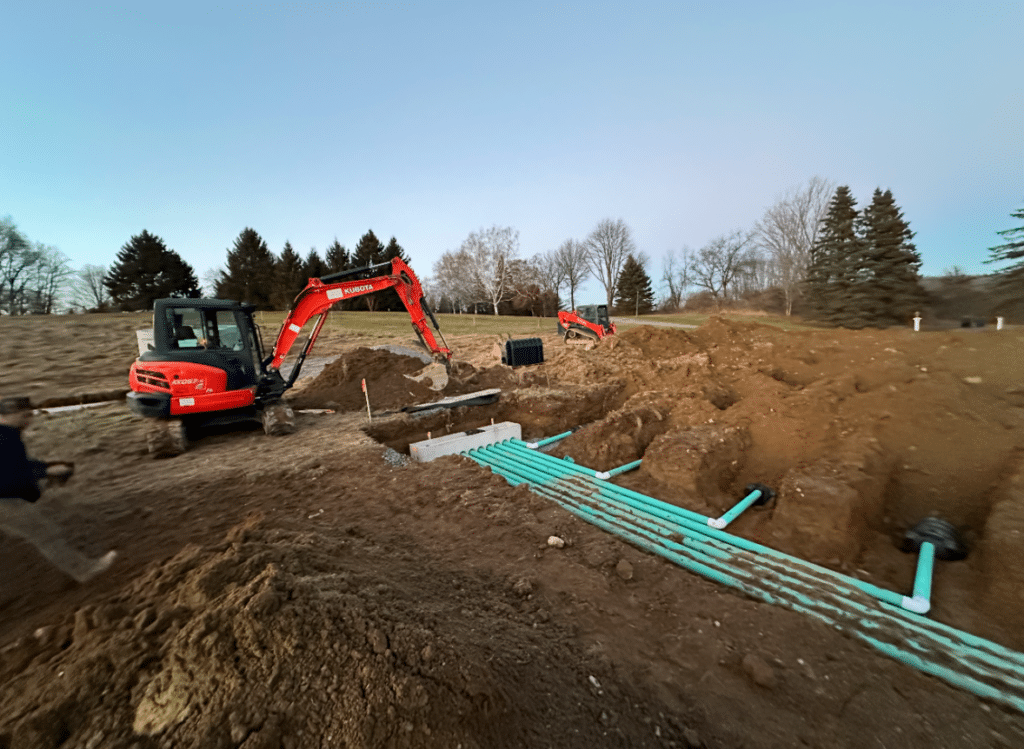
Where severe mechanical or structural failures emerge, targeted excavation and utility trenching may be necessary to correct unpitched pipe runs, replace crushed SDR-35 main lines, or install deep foundation curtain drains. Combining heavy earthmoving capabilities with non-invasive jetting equipment allows site technicians to fix immediate hydraulic blockages while upgrading underlying site infrastructure to withstand severe regional freeze-thaw cycles.
Regional Case Studies: Lessons from the Field
Scenario 1: The Mountainous Clay Failure (Wayne County, PA)
A residential property built on a hillside in Wayne County suffered recurring basement backups every spring thaw. Initial inspections showed that the home’s effluent distribution lines had been laid in high-density clay soil. Over time, neglected pumping allowed fine sludge to pass into the distribution box, completely clogging the upper two laterals.
During the winter, wastewater forced its way into the lower single lateral, overloading the surrounding soil. The saturated clay froze, expanding vertically and crushing the perforated lateral pipe.
The Solution: Site technicians performed an emergency pump-out of the primary septic tank, removing over six inches of packed bottom sludge. They then cleared the remaining intact laterals using high-pressure jetting to flush out accumulated bio-film. Finally, targeted excavation replaced the crushed lateral section with heavy-duty pipe surrounded by washed clean stone and a protective geotextile barrier, fully restoring the system’s hydraulic capacity.
Scenario 2: The Freeze-Dammed Commercial Line (Northern NJ)
A commercial office complex in northern New Jersey experienced complete drain failure during an extreme subzero week in January. Multiple plumbers had attempted to cable snake the 6-inch cast-iron main line, but the snake merely punched small holes through a thick core of frozen grease and paper products, causing the line to re-freeze hours later.
The Solution: Technicians deployed a trailer-mounted, hot-water hydro-jetting unit. Delivering 3,800 PSI at 180°F, the heated water stream melted the ice core, dissolved years of saponified grease along the top and sides of the pipe wall, and flushed the debris out to the municipal sewer tie-in. The process restored the full 6-inch capacity of the pipe, eliminating the restriction that caused water to pool and freeze.
External References
For technical guidelines on rural wastewater management, soil classifications, and cold-weather infrastructure protection, consult the following authoritative resources:
-
US EPA: Decentralized Wastewater Systems Management — Federal engineering standards, biological treatment principles, and homeowner maintenance frameworks.
-
PA DEP: Onsite Wastewater Systems Program — Pennsylvania state regulations governing mound design, perk testing, and environmental compliance.
Key Takeaways
-
Pump Primary Tanks Regularly: Schedule septic pumping every 3 to 5 years (or sooner based on occupancy) to stop solids from escaping into and ruining the leach field.
-
Jet Drains for Complete Cleaning: Use high-pressure water jetting rather than standard cable snaking to clean grease, scale, and heavy biomass all the way to the pipe wall.
-
Protect Distribution Boxes & Sand Mounds: Keeping solids out of dosing chambers prevents impeller damage, protects check valves, and avoids costly mound replacements.
-
Maintain Exterior Foundation Drains: Clear perimeter French drains of fine silt and roots to relieve hydrostatic pressure and protect foundation walls from winter frost-heaving.
-
Address Pipe Sags Before Winter: Flush out build-ups in sagging pipes before winter so water doesn’t pool, sit still, and freeze solid inside the line.
Direct Call to Action
Hydraulic failures, frozen sewer lines, and overwhelmed septic leach fields require immediate intervention by experienced professionals equipped with heavy machinery and specialized high-pressure diagnostic equipment. Whether you are managing an aging rural septic system, troubleshooting a commercial drainage emergency, or preparing a residential site for severe Tri-State winters, Triple J Services delivers field-tested expertise.
Protect your land, property value, and foundation infrastructure today. Call Triple J Services directly at (845) 750-5222or visit triplejservices.tech to schedule a comprehensive site evaluation, septic tank pumping, or high-pressure drain jetting service.