If you ask five different neighbors in Pike County how often you should pump your septic tank, you will probably get five completely different answers. One might swear you need to do it every single year. Another will tell you they haven’t touched their tank in a decade and everything works just fine.
Relying on neighborhood gossip for your home’s wastewater infrastructure is a dangerous game. If you wait until raw sewage bubbles up into your bathtub to think about your system, you have waited far too long.
Out here in Lackawaxen, PA, our unique mountain geography, rocky soil, and seasonal population shifts mean there is no single rule of thumb that fits every household.
How often you actually need to empty your tank depends on a mix of state environmental guidelines, the physical size of your tank, and the daily habits of the people living under your roof.
Taking the time to understand these variables keeps your plumbing running smoothly and prevents thousands of dollars in sudden, messy repair costs.
The Basic Science of a Septic Tank
To figure out a solid pumping schedule, you have to look at what happens inside the buried concrete or fiberglass box in your yard. Every drop of water that goes down your sinks, toilets, and showers flows directly into this main holding tank.
Once inside, gravity does most of the heavy lifting. The waste naturally separates into three distinct layers.
The heavy, solid waste drops straight to the bottom, forming a thick layer called sludge. The lightweight fats, oils, and grease float to the top, creating a crusty layer called scum.
The middle section is filled with relatively clear liquid waste, known as effluent. This liquid is the only part that is supposed to exit the tank, flowing out to your filtration field or elevated sand mound for final purification.
Naturally occurring bacteria live inside the tank and constantly work to eat away at the organic matter. They liquefy much of the solid waste.
However, these microbes cannot dissolve everything. Over months and years of daily use, the sludge layer at the bottom grows thicker, and the scum layer on top grows deeper.
If you do not manually pump these layers out, they will eventually displace the clear liquid space. When that happens, raw solids get pushed straight out into your delicate yard lines.
The Pennsylvania State Regulatory Baseline
Pennsylvania takes wastewater management seriously because our beautiful rural landscapes sit right on top of clean groundwater tables. According to environmental standards set by the Pennsylvania Department of Environmental Protection (DEP), regular maintenance is crucial for preventing community-wide water pollution.
Many local municipalities across Pike and Wayne counties have established official ordinances to enforce regular upkeep. In many local townships, homeowners are legally required to have their septic tanks inspected and pumped out by a registered professional at least once every three years.
These local regulations are designed as a safety net. They ensure older systems do not slowly leak into the environment undetected.
Even if your local municipality does not actively enforce a strict three-year countdown, using that timeline as your maximum baseline is a smart, defensive move for any property owner.
Full-Time Homes vs. Seasonal Vacation Cabins
One of the biggest factors that dictates your custom pumping schedule is how many days a year the home is actually occupied. The Poconos region is full of beautiful weekend retreats, summer cabins, and short-term rental properties that experience wildly different usage patterns than a traditional full-time residence.
A full-time home sees a steady, predictable daily stream of wastewater. The bacterial ecosystem inside the tank stays warm, fed, and active all year long. Because the volume is consistent, a standard three-year schedule works beautifully for most full-time households.
A seasonal vacation cabin behaves completely differently. The home might sit completely dark and empty from November through April.
Without any fresh waste entering the tank, the beneficial bacteria starve and the biological breakdown process stops entirely.
Then, summer arrives. The cabin suddenly welcomes a rotating crowd of family, friends, or vacation renters.
This brings us to a phenomenon known as shock loading. This occurs when an immense volume of water from back-to-back showers, multiple loads of laundry, and constant toilet flushes hits a dormant system all at once.
The sudden rushing water stirs up the settled sludge at the bottom of the tank, pushing solid particles directly out into your filtration zone before they have a chance to break down.
If you own a seasonal cabin or run a popular short-term rental, you might actually need to pump your tank more frequently—often right before or right after the busy summer season—even though the home sits empty for half the year.
The Size of the Family Matters
It stands to reason that a home with seven people living under one roof creates significantly more waste than a home with a retired couple. The physical size of your buried tank can only accommodate a set amount of daily fluid volume.
A small family or a single person living in a home with a standard 1,000-gallon tank can easily push their pumping interval out toward the three-to-four-year mark. The accumulation rate of sludge is naturally slow, giving the tank plenty of space to function.
A large family living in that exact same house will fill that 1,000-gallon tank with solids at a rapid pace. More people means more toilet paper, more food particles down the kitchen sink, and a massive amount of daily graywater from washing machines and dishwashers.
For households with four or more full-time residents, waiting three years can be a massive gamble.
These high-occupancy homes often require professional pumping every one to two years to stay ahead of the rapid solid accumulation and prevent sudden system overloads.
The Unique Challenges of Poconos Soil and Geography
Where your house sits in Pennsylvania plays a massive role in how well your system handles waste. Pike County is famous for its rocky terrain, clay-heavy soils, and shallow mountain bedrock.
Traditional, old-school gravity leach fields require deep, sandy soil to absorb and filter wastewater naturally as it sinks into the earth. Because our local ground layers are often thin or full of hard shale, standard underground trenches often cannot be installed safely or legally.
To bypass these natural dirt limitations, many local homes use advanced engineering. You will frequently see large, raised mounds of earth built right on top of local lawns.
Locals commonly call these “Turkey Mounds.” These engineered sand mound configurations use specific layers of sand and gravel built above the natural grade to treat water safely.
Because Turkey Mounds are elevated, they are highly exposed to weather elements and surface changes. They are also incredibly expensive to repair or replace if they get ruined by escaping solids.
If you let your holding tank fill up with too much sludge, those solid particles will float right out into the sand layers of your Turkey Mound, plugging the tiny gaps between the sand grains.
Once a mound is blinded by solids, it loses its ability to filter water, leading to soggy spots on your lawn, foul odors, and eventual system failure. Keeping your main tank regularly cleared out is the cheap insurance policy that protects this expensive mound.
Mechanical Pumps Demand Clean Liquid
Many mountainous properties don’t just rely on simple gravity to move wastewater. Because of the rolling hills and changing elevations, many setups require mechanical intervention.
A grinder pump functions like a heavy-duty industrial disposal unit, sitting in a separate well to grind up solid waste and push it uphill to a main line. An effluent pump moves clarified wastewater from a secondary chamber up into an elevated sand mound.
These mechanical units require a relatively clean environment to do their jobs safely. If you neglect your pumping schedule and allow thick sludge or grease to spill over into the pump chamber, you create an immediate mechanical hazard.
Solid waste will wrap around the spinning impeller blades, bind the motor, and cause the pump to burn out completely.
A failed pump will trip your home’s main electrical breakers, trigger a loud, screaming high-water alarm on your exterior control panel, and can cause a total sewage backup into your lower living spaces. Regular tank pumping keeps these solids far away from your expensive mechanical components.
Cleaning Stubborn Lines with Hydro-Jetting
Sometimes, the bottleneck in your system isn’t inside the tank itself, but in the main lateral line that connects your house to the yard. Over years of daily use, grease, soap scum, and small debris build up along the inner walls of your pipes. This narrows the pipe diameter and causes your sinks to gurgle or your toilets to flush sluggishly.
If you have a slow line, never pour harsh chemical cleaners down the drain. These acidic mixtures rarely clear a deep clog, can ruin your pipes, and will kill off the beneficial tank bacteria that keep your system alive.
Traditional mechanical snakes can punch a temporary hole through a major blockage, but they leave behind a greasy coating.
High-pressure drain jetting, commonly known as hydro-jetting, is a far superior modern solution. This process uses a specialized nozzle that blasts highly pressurized water in all directions inside the line.
The intense water streams scour the inner walls completely clean, emulsifying years of grease and cutting through stubborn tree roots. Scheduling a hydro-jetting service alongside your regular tank pumping ensures your entire infrastructure is completely clear from the house to the drain field.
The Power of Preventative Septic Inspections
The absolute best way to figure out your exact pumping frequency is to replace guesswork with real data. You should never wait for a plumbing disaster to check on your system.
Scheduling a regular professional septic system inspection provides a complete health report for your underground utilities.
Technicians use advanced sewer cameras attached to flexible rods to look directly inside your main lines, identifying structural cracks, sagging pipe sections, or invasive tree roots early.
They also use specialized measuring tools to check the exact thickness of your tank’s sludge and scum layers.
An inspection removes the mystery, telling you precisely how many inches of room you have left so you can plan your next maintenance visit calmly on your own schedule.
Excavation, Drainage, and Long-Term Upgrades
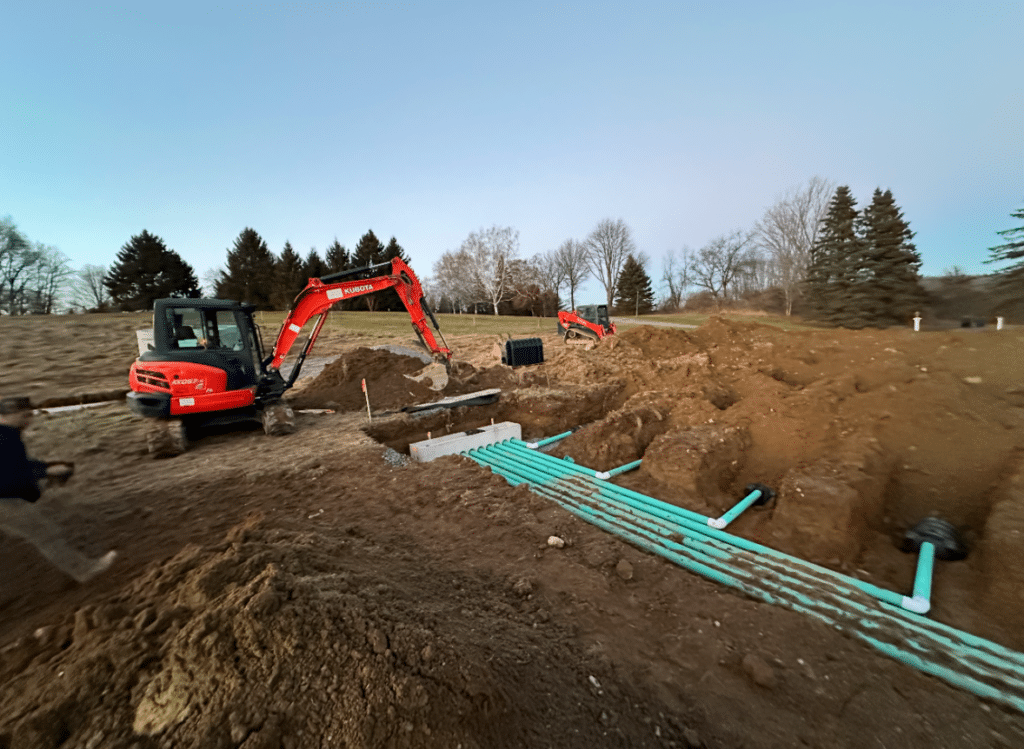
If you have recently purchased an older rural property, you might find that the existing infrastructure simply cannot handle modern household demands. Over decades of shifting mountain soil and freezing winters, older concrete or steel tanks can degrade, crack, or cave in entirely.
If your system struggles to drain despite frequent pump-outs, you may need to look into a comprehensive septic system installation and replacement. According to safety and construction guidelines from the Occupational Safety and Health Administration (OSHA), any professional utility trenching and excavation must be managed with precise care to protect surrounding structures and avoid soil collapses.
Modern waste engineering uses highly durable materials and advanced structural tanks buried deep beneath the regional frost line.
Additionally, if your yard suffers from poor natural grading, heavy rain and melting snow can saturate the soil around your filtration area.
Installing targeted French drains and custom drainage solutions around the perimeter redirects surface runoff away from your system, keeping the ground stable and allowing your field to process wastewater efficiently.
Rooted in Lackawaxen and Pike County
When you need essential infrastructure care, you don’t want to deal with a national corporate chain that treats you like an invoice number, or a general handyman who treats septic work as a side hustle. You need a dedicated specialist who understands local soils, mountain terrain, and regional climate challenges.
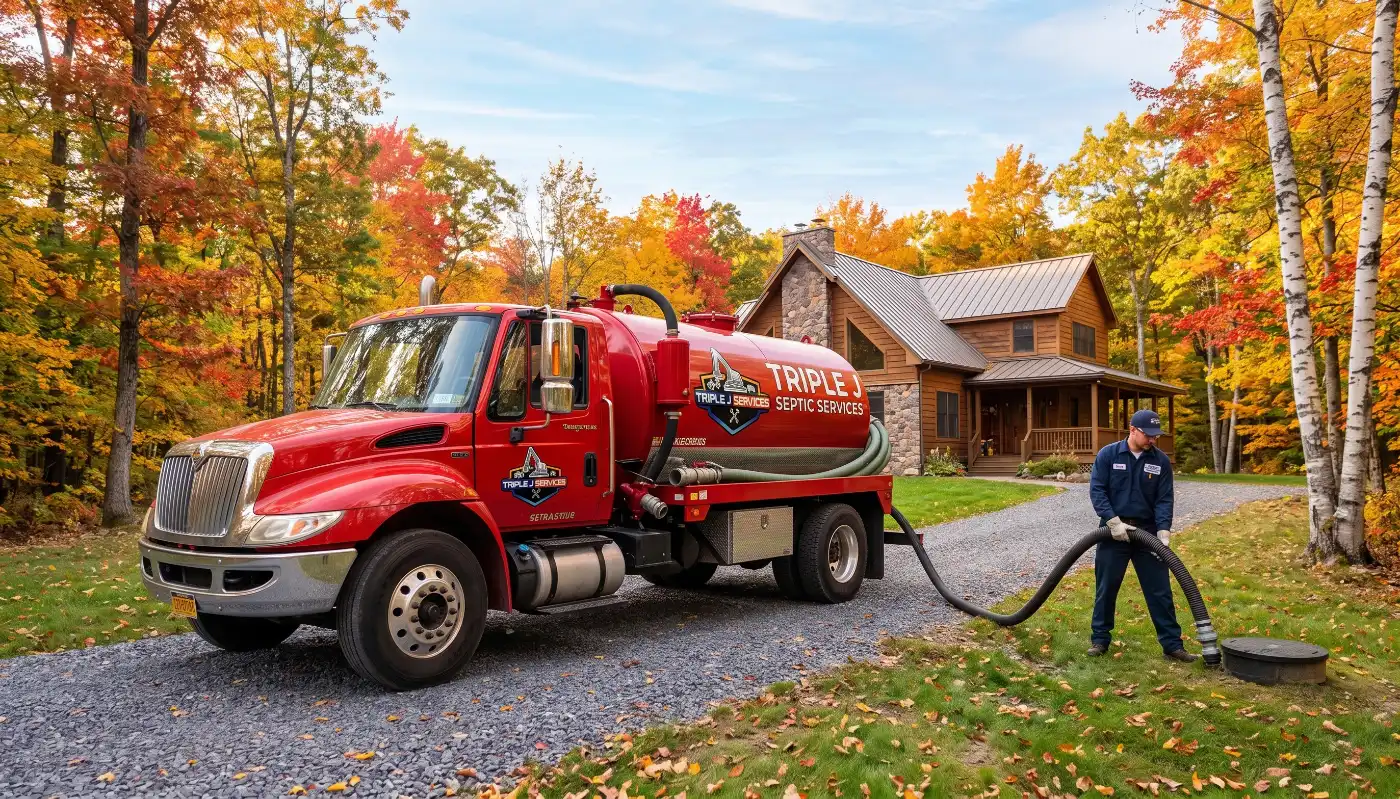
Triple J Services is located right here in Lackawaxen, PA. We are your proud Pike County neighbors, and we treat every single property with the exact same care, pride, and accountability we bring to our own homes.
Our owner, John Dreizler, built this company on a foundation of grit, strong family values, and total honesty. We don’t believe in cutting corners, and we never make inflated promises just to drive up profits.
We focus our training, heavy machinery, and daily energy entirely on essential subsurface utilities, pump mechanics, and specialized excavation. We master what we do so you can rest easy knowing your home is protected.
Whether you need a routine inspection to check your sludge levels, high-pressure hydro-jetting to clear a slow pipe, an emergency pump-out, or a complete system installation, we are here to deliver honest answers, transparent pricing, and dependable local solutions you can count on.
Article Recap
-
Pennsylvania DEP guidelines and local municipal ordinances often require a baseline septic tank pumping at least once every three years.
-
Full-time homes see a consistent waste volume that keeps tank bacteria healthy, while seasonal cabins suffer from dormancy and rapid summer shock loading.
-
Large families generate significantly more daily graywater and solid waste, often requiring a pump-out every one to two years.
-
Small families or single residents accumulate sludge at a slower rate, allowing them to safely stick closer to a three-to-four-year schedule.
-
Neglecting your pumping schedule allows solid sludge to escape the tank, blinding the delicate sand layers of expensive Turkey Mounds.
-
Excess solids will wrap around the spinning impellers of grinder and effluent pumps, burning out the motors and triggering high-water alarms.
-
Professional inspections eliminate the guesswork by measuring your tank’s exact sludge depth down to the inch.
Do not wait for a loud pump alarm or a messy backup to find out if your tank is full. Protect your home and family today by reaching out to the trusted local experts at Triple J Services.
Whether you need to schedule your routine three-year compliance pumping, clear out slow drains with high-pressure hydro-jetting, or check your tank’s health with a professional camera inspection, our team brings the specialized tools and local knowledge required to get the job done right.
Give us a call today at (845) 750-5222 or visit our Services Page to request your free estimate. Let us handle the hard work so you can enjoy total peace of mind.