The Best Time of Year to Schedule Septic Pumping in PA
Most homeowners do not think about their septic tank until something goes terribly wrong. It is an understandable habit. The system is buried underground, out of sight and out of mind, quietly processing wastewater every single day.
But ignoring that tank eventually leads to a rude awakening. It usually happens at the worst possible moment—midway through a holiday weekend, during a heavy downpour, or in the dead of winter when the ground is frozen solid. Suddenly, your drains slow to a crawl, a foul odor drifts into the yard, or worse, raw sewage backs up into your home.
Dealing with a middle-of-the-night pumping emergency is stressful, messy, and entirely preventable. Taking control of your home maintenance means understanding the best time of year to schedule your septic service in Pennsylvania. By planning ahead, you save money, protect your property, and avoid the chaotic panic of an emergency service call.
Why Timing Matters for Pennsylvania Homeowners
Pennsylvania weather is beautiful, but our distinct seasons present unique challenges for underground infrastructure. Choosing the right month for routine maintenance is not just about convenience. It directly impacts how easily the job can be done and how well your system performs afterward.
The Spring Thaw and Rainy Season
Spring brings warmer weather, but it also brings heavy rain and melting snow. In places like Milford and Dingmans Ferry, the water table rises significantly during these months.
When the ground is completely saturated with water, scheduling a routine pump-out can become problematic. Muddy yards make it difficult to bring heavy excavation and pumping equipment onto the property without tearing up the turf or creating deep ruts. Furthermore, a highly saturated drainfield can sometimes push water back into an emptied tank if the system is already struggling, making spring a less-than-ideal window for standard maintenance.
The Hard Freeze of Winter
Winter is arguably the toughest time to address septic issues in Pike County. When temperatures drop below freezing, the top layers of soil turn rock-hard.
If your tank lids are buried, locating and digging them out requires chipping through frozen dirt. This extra labor drives up service times and costs.
Cold weather also strains the biological components of your system. The beneficial bacteria that break down solids inside your tank slow down significantly in freezing temperatures. Emptying a tank in the dead of winter removes the warm wastewater that keeps the system from freezing, which can occasionally expose vulnerable pipes to frost damage if not managed properly.
Summer and Fall: The Golden Window
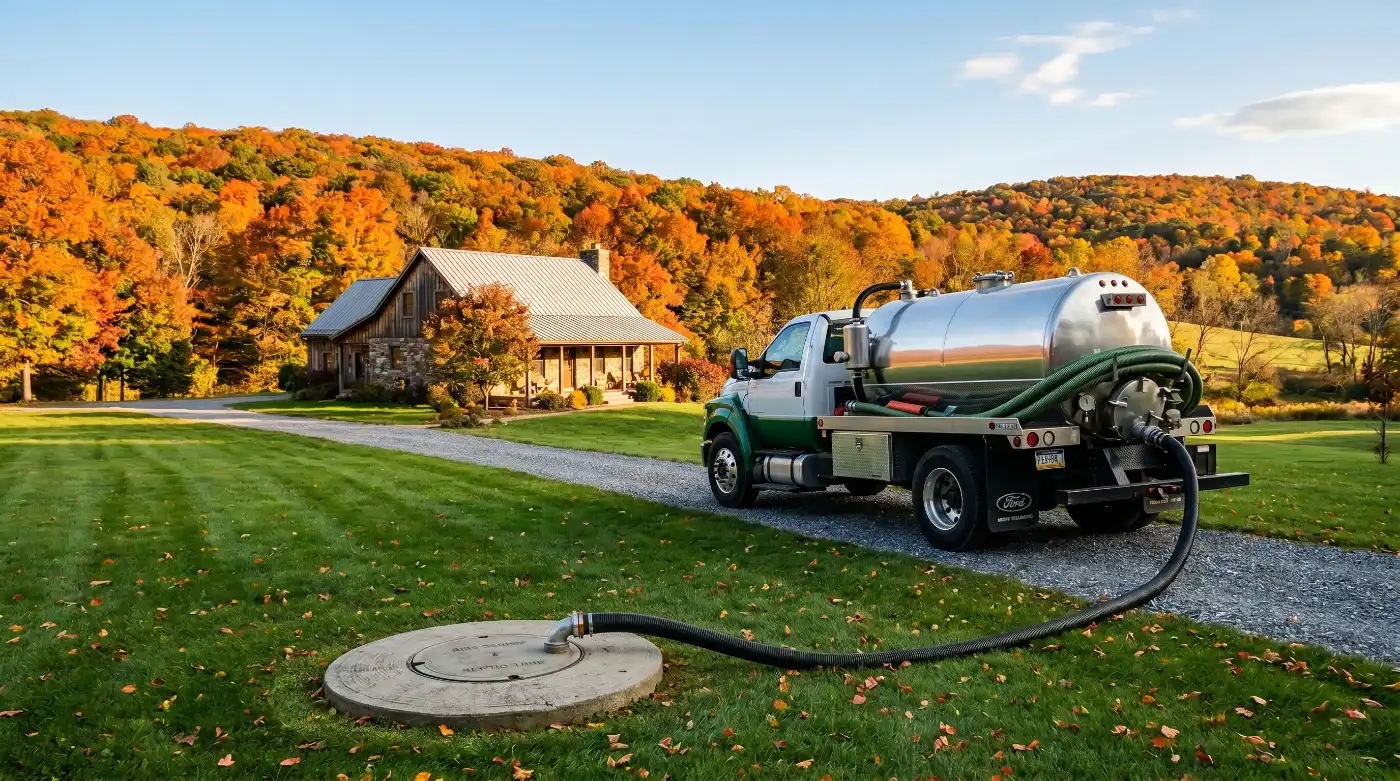
For the vast majority of PA residents, the dry months of summer and early fall are the absolute best times to schedule a pump-out. The ground is dry, firm, and easy to dig. This minimizes any risk of lawn damage from service vehicles.
Getting your system serviced in August, September, or October also prepares your household for the upcoming winter stretch. You enter the coldest months of the year with an empty tank, fully functional baffled walls, and an optimal environment for healthy bacterial action.
Proactive Maintenance vs. Midnight Emergencies
Waiting for your septic system to show signs of failure before calling a specialist is a risky gamble. A backed-up tank does not just stay confined to the backyard. It can force wastewater back up through your toilets, showers, and sinks, causing thousands of dollars in water damage and creating a serious health hazard.
Emergency situations also disrupt your life. Imagine hosting a houseful of guests for Thanksgiving or a summer barbecue, only to have your plumbing completely fail because the tank reached its maximum capacity.
When you schedule standard, non-emergency service, you are operating on your own timeline. You can pick a day that works for your schedule, the technician can perform a thorough visual inspection of the tank components in daylight, and the cost is entirely predictable.
If you do find yourself facing an unexpected failure, immediate help is vital. The team at Triple J Services provides reliable emergency septic pumping services across the region to resolve critical backups before they ruin your property.
How Often Should You Pump? The Size and Usage Equation
There is no single, one-size-fits-all answer to how frequently a septic tank needs to be cleaned out. Frequency depends on three main variables: the volume of the tank, the number of people living in the house, and the volume of solids entering the wastewater stream.
As a general rule of thumb, the Environmental Protection Agency (EPA) recommends that residential septic tanks be inspected at least every three years, with actual pumping occurring every three to five years. However, high-occupancy homes or smaller tanks require a tighter schedule.
Small Homes and Couples (1–2 People)
If you live alone or share a home with a partner, your system experiences relatively light daily use.
-
750-Gallon Tank: A smaller tank paired with two occupants will typically need service every 4 to 5 years.
-
1,000-Gallon Tank: With a standard thousand-gallon tank, a two-person household can easily go 5 yearsbetween routine pump-outs, provided they do not misuse their drains.
Average Family Homes (3–4 People)
This is the standard baseline for suburban and rural properties throughout Lackawaxen and Pike County. Daily water usage from multiple showers, laundry cycles, and dishwashers adds up quickly.
-
1,000-Gallon Tank: A family of three or four utilizing a standard tank should schedule maintenance every 3 years.
-
1,250-Gallon Tank: A slightly larger tank gives you a bit more breathing room, stretching the ideal window out to roughly 4 years.
Large Households and Busy Homes (5+ People)
When you have five or more individuals under one roof, the sheer volume of solid waste and wastewater entering the tank changes the math completely. The system has less time to settle and break down solids before new waste pushes through.
-
1,000-Gallon Tank: A large family using a standard tank is pushing the system to its upper limits. You should plan on a pump-out every 1 to 2 years to avoid sudden overflows.
-
1,500-Gallon Tank: Even with a heavy-duty 1,500-gallon tank, a large household needs routine servicing every 3 years to keep the drainfield from getting clogged with fine solids.
Warning Signs that Your Tank is Nearing Critical Mass
You do not have to fly completely blind between your scheduled service dates. Your home will usually drop subtle hints that the septic system is getting full and needs professional attention. Paying attention to these early warnings can save you from a major headache.
Gurgling Pipes and Slow Drains
If you notice that your kitchen sink takes an unusually long time to empty, or if your bathroom pipes emit a distinct gurgling sound when the washing machine drains, it is a sign of restricted flow. While it could be a localized clog, it often indicates that the wastewater inside your septic tank has risen above the inlet pipe, slowing down the exit of water from your home.
Unusually Lush, Green Grass
Walk out to your backyard and look at the area directly over your tank and drainfield. Is the grass noticeably greener, taller, or thicker than the rest of your lawn? While it might look nice, it is actually a red flag. It means raw wastewater is rising too close to the surface of the soil, effectively over-fertilizing your lawn because the tank can no longer contain or properly filter the volume.
Odors indoors or Outdoors
A properly functioning septic system keeps all gases and odors safely contained underground. If you step out onto your patio and catch a strong whiff of rotten eggs or sewage, something is wrong. Similarly, if sewage odors begin escaping from your indoor drains, your tank’s baffles or vent systems may be compromised due to excessive sludge accumulation.
The Vital Role of Specialized Septic Pumps
A standard gravity-fed septic system relies entirely on natural slopes to move water from the house, into the tank, and out to the leach field. However, many homes in our region are built on uneven terrain, rocky ledges, or steep hillsides. These properties require mechanical help to transport wastewater effectively.
Effluent Pumps
An effluent pump sits in a dedicated chamber or tank at the back end of your septic system. Its job is to pump clarified wastewater uphill to a raised drainfield or a mound system.
Because these pumps handle liquid that has already been separated from heavy solids, they are highly efficient but still require routine inspection. If an effluent pump fails, wastewater cannot leave the system, causing the entire setup to back up into the house within hours. Routine maintenance checks ensure your pump’s float switches and electrical connections are clean and fully operational. For expert support, you can explore professional effluent pump serviceoptions to keep things flowing smoothly.
Grinder Pumps
Unlike an effluent pump, a grinder pump handles raw, un-separated sewage. It uses high-speed grinding blades—much like a heavy-duty garbage disposal—to pulverize solid waste, toilet paper, and wastewater into a fine slurry. Once ground down, this slurry is pumped under high pressure through narrow pipes to either a public sewer main or a distant septic tank.
[Raw Sewage Input] ---> [Grinder Pump Blades] --->
[Fine Slurry Output] ---> [Pressure Line]
Grinder pumps are critical pieces of machinery that operate under harsh conditions. They are highly susceptible to damage if household members flush improper items like wet wipes, feminine products, or cooking grease.
When a grinder pump malfunctions, an audible or visual alarm on your control panel will trigger, alerting you that the water level inside the pump chamber is dangerously high. Ignoring this alarm guarantees a massive backup. If your system is buzzing or flashing, securing trusted grinder pump repair & emergency services immediately is the only way to prevent property damage.
Best Practices to Extend the Life of Your Septic System
While regular pumping is the foundation of good septic health, how you treat your system on a daily basis plays a massive role in how well it runs between service visits. Implementing a few simple habits can save you thousands of dollars in premature repairs or early septic system installation costs.
-
Watch the Washing Machine: Spacing out laundry loads across the entire week is much better for your system than doing five loads in a single Saturday. Dumping massive volumes of water into the tank all at once agitates the solids, pushing un-decomposed waste directly into your drainfield.
-
Ditch the “Flushable” Wipes: Despite what the packaging claims, wet wipes do not break down in a septic tank. They sink to the bottom, rapidly filling up the sludge layer, or they get caught in your pump blades, burning out the motors.
-
Keep Chemicals out of the Drains: Avoid pouring heavy chemical drain openers, paint thinner, bleach, or motor oil down your sinks. These harsh substances kill off the beneficial bacteria your tank relies on to break down solid waste naturally.
-
Protect the Drainfield: Never park cars, drive heavy machinery, or build permanent structures like sheds or decks on top of your septic tank or leach field. Heavy weight compacts the soil and can easily crack underground PVC pipes or the concrete tank structure itself.
Trust the Local Experts at Triple J Services
Your septic system is one of the most vital components of your home’s infrastructure. Entrusting its care to a dedicated, experienced team ensures the job gets done right the first time without shortcutting the safety of your property.
At Triple J Services, we approach every job with the integrity, skill, and transparency that our neighbors across Pike County deserve. We are a family-centered, excavation-led team with decades of hands-on experience under our belts. We don’t just pump out tanks; we analyze the overall health of your infrastructure, troubleshoot complex pump issues, and provide clear, straightforward advice on how to keep your system running perfectly for years to come.
Whether you need to schedule a routine autumn pump-out, inspect an aging mound system, or get immediate help with a failing pump, we are the local professionals you can depend on. Learn more about us and discover how our deep community roots translate into unmatched service quality for your home.
Quick Summary: Septic Pumping
-
The Best Time to Pump: Late summer and early autumn (August through October) offer dry ground conditions and easy digging before the winter freeze settles in.
-
Pumping Frequency: Ranges from every 1 to 2 years for large households down to every 5 years for small, two-person homes with minimal water usage.
-
Avoid the Emergency Rush: Routine maintenance pumping is predictable, less disruptive, and far more affordable than a frantic midnight call for an active sewage backup.
-
Pump Mechanics Matter: Keep a close eye on effluent and grinder pumps. A failing pump switch or a triggered alarm requires immediate professional remediation.
Protect Your Property Today
Do not wait for an unpleasant backup to tell you that your septic tank is full. Take a proactive step to protect your home, your family, and your wallet by scheduling your routine maintenance today. The expert team at Triple J Services is standing by to assist with all of your pumping, inspection, and system replacement needs across Pike County.
Get in touch with us directly through our contact page